
The Mayan Civilization: Timeline, Cities, Achievements and What Really Happened to It

The Maya civilization spanned 3,000 years across southern Mexico and Central America. Its timeline, cities, writing, maths, why the southern lowlands collapsed, and where to see it standing today.
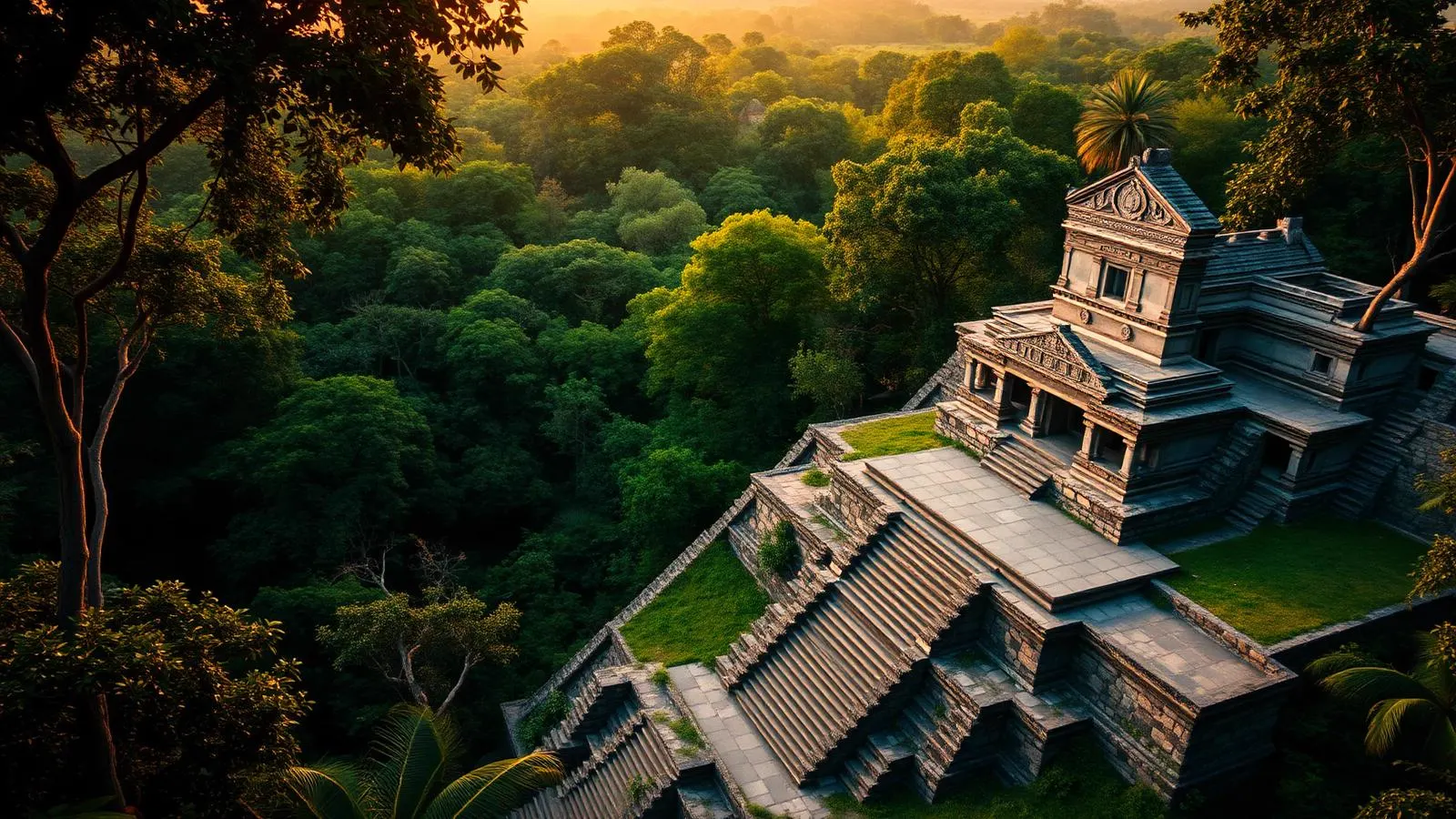
The Mayan civilization ran for roughly 3,000 years across southern Mexico and northern Central America, peaking as dozens of independent city-states rather than one empire. It produced the Americas' only complete writing system, a positional zero, and cities engineered to survive on rainfall alone.
Timeline: From Preclassic Villages to the Last Maya Capital
Four periods organise 3,000 years. The Preclassic builds the first cities, the Classic produces the dynasties, inscriptions and the southern collapse, the Postclassic shifts power north to Yucatan, and the colonial period ends Maya political independence in 1697, not in 1521.
| Period | Dates | What defines it | Leading cities |
|---|---|---|---|
| Preclassic | 1800 BC - 250 AD | First cities, early writing, massive platforms | El Mirador, Nakbe |
| Classic | 250 - 900 AD | Dynastic kings, dated stelae, peak population | Tikal, Calakmul, Palenque, Copan |
| Postclassic | 900 - 1524 AD | Northern shift, coastal trade, council rule | Chichen Itza, Mayapan, Tulum |
| Colonial | 1524 - 1697 | Conquest, resistance, fall of Nojpeten | Merida, Nojpeten |
How Maya City-States Governed Without an Empire
The Maya never unified politically. Each major city ran as an independent kingdom under a k'uhul ajaw, a holy lord, tied to others by marriage, tribute and war. Two superpowers, Tikal and Calakmul, spent the Classic period pulling smaller kingdoms into rival alliance networks.
Northern Yucatan later experimented with something different. Chichen Itza shows less emphasis on single-ruler portraits and more on council imagery, a shift traced through its construction phases in the Chichen Itza history guide.
Writing, Mathematics and Astronomy the Maya Actually Invented
Maya script combined about 800 signs, mixing syllables with whole-word glyphs, and it recorded history, not just ritual. Their number system used base 20 with a positional zero, which made calculations of enormous date spans practical on bark paper and stone.
Those numbers powered a calendar of interlocking cycles, and the mechanics of the Tzolk'in, Haab' and Long Count are explained in the Mayan calendar guide. Astronomers tracked Venus so precisely that their tables drift by hours per century, work done from buildings like El Caracol observatory.
Religion as State Infrastructure
Kings justified taxation and labour through ritual duty: they fed the gods and the rain arrived. The deities behind that contract, Chaac, Itzamna and the rest, are covered in the Mayan gods guide.
What Caused the Classic Collapse in the Southern Lowlands
Between roughly 800 and 900 AD, the southern lowland cities stopped raising monuments and emptied within a few generations. Sediment and cave records show repeated droughts, some lasting decades, hitting a landscape already stripped of forest and farmed to exhaustion.
Drought alone does not explain it. Kingship depended on the promise of rain, so failed harvests undermined the whole legitimacy system, and warfare intensified exactly when cooperation was needed. The north, with its cenote water supply, absorbed migrants and prospered for another 300 years.
Where the Maya World Still Stands in Mexico
The Yucatan peninsula holds the densest concentration of visitable sites, from monumental capitals to small coastal outposts. A ranked overview of what each one offers sits in the Mayan ruins in Mexico guide.
Three contrasting examples make the timeline tangible in one trip. Ek Balam preserves a stucco frieze that survived because it was buried, described in the Ek Balam ruins guide, while the clifftop trading port covered in the Tulum ruins guide shows the late coastal Maya still operating when Spanish ships appeared.
Seeing 3,000 Years of Maya History in a Single Day
Chichen Itza works as a summary of the whole civilization because it inherited it. Its architecture blends Puuc facades from the west, central Mexican serpent columns, astronomical design from Classic tradition, and a water supply that decided where the last great capital could exist.
Reading that layering needs a guide who knows the periods apart. Every Chichen Itza tour we run uses certified INAH guides, several of them native Yucatec Maya speakers, and Itza Quest keeps groups private so the history conversation actually happens.
One ritual runs through every period above, from Preclassic villages to Chichen Itza's 168-metre arena: the ball game. Its rules, equipment, mythology and the question of who was actually sacrificed are covered in the Mayan ball game guide.
Continue reading
Related guides with the same travel intent.
Frequently Asked Questions
When did the Mayan civilization begin and end?
Settled Maya villages appear by roughly 1800 BC, cities and writing by 250 AD, and Spanish conquest ends Maya political independence in 1697 with the fall of Nojpetén. The civilization never ended as a people: around six million Maya live in Mexico and Central America today.
Where was the Mayan civilization located?
The Maya area covers about 324,000 square kilometres across southern Mexico, Guatemala, Belize, western Honduras and El Salvador. It splits into three zones: the northern Yucatan lowlands, the southern Peten lowlands, and the volcanic highlands of Guatemala and Chiapas.
Why did the Mayan civilization collapse?
The southern lowland collapse around 800-900 AD came from several pressures at once: repeated multi-decade droughts, soil exhaustion from intensive farming, endemic warfare between city-states, and loss of faith in kings who claimed to control rain. Northern cities like Chichen Itza kept growing.
What were the greatest Mayan achievements?
The Maya built the only fully developed writing system in the pre-Columbian Americas, used positional notation with a zero centuries before Europe, tracked Venus to an accuracy of hours per century, and engineered rainwater cities on porous limestone with no rivers.
Do the Maya still exist today?
Yes. About six million Maya people live across Mexico, Guatemala, Belize and Honduras, speaking around 30 Mayan languages including Yucatec, K'iche' and Q'eqchi'. Yucatec Maya is still spoken daily in the villages surrounding Chichen Itza and Valladolid.
Which Maya city was the most powerful?
Power shifted by era. Tikal and Calakmul dominated the Classic period as rival superpowers, El Mirador led the Preclassic with the largest pyramid by volume, and Chichen Itza controlled northern Yucatan after 900 AD as the last great Maya capital.