
Mayan Writing: How the Hieroglyphic Script Worked and How It Was Finally Read

Mayan writing explained: how the hieroglyphic script works, logograms and syllables, the Dresden Codex, who decoded it, and where to read real glyphs in the Yucatan today.
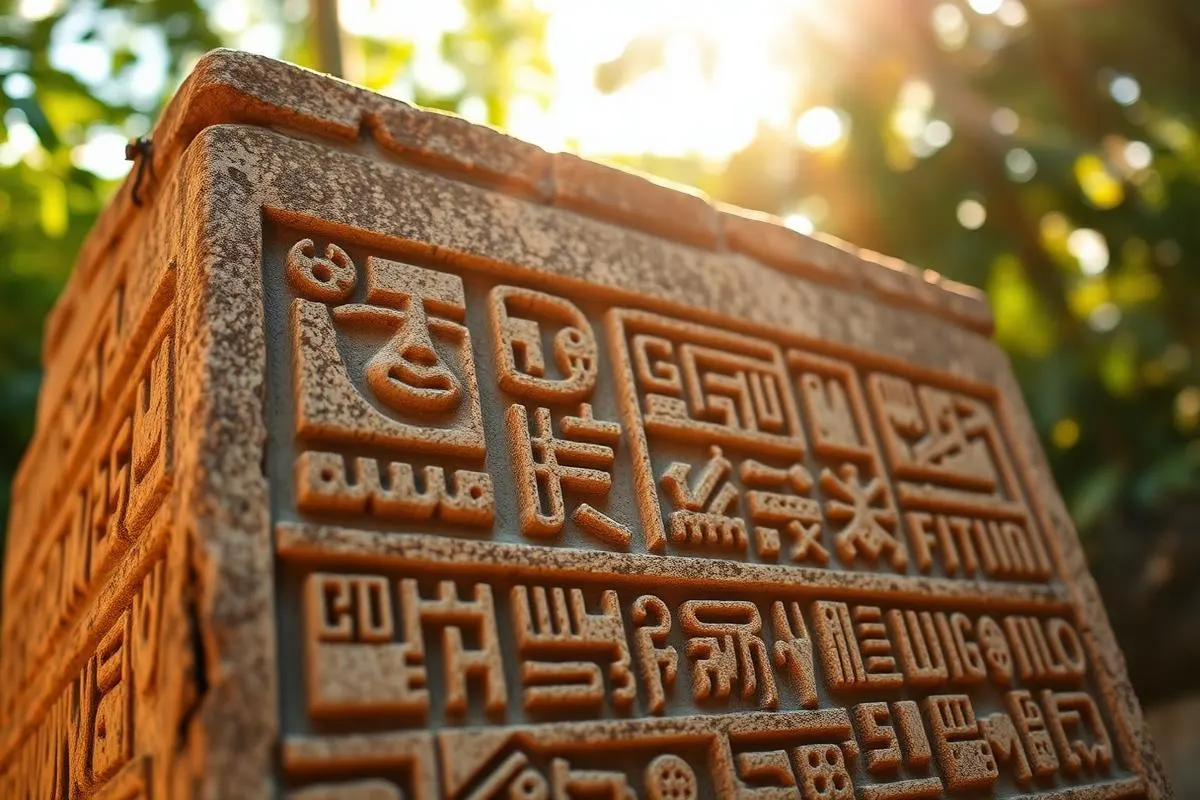
Mayan writing is a logosyllabic script of roughly 800 signs that recorded a spoken language, not a set of picture symbols. Scribes mixed word-signs with syllables inside square blocks, read in paired columns, and used it for history, astronomy, ritual and royal propaganda.
Logograms, Syllables and the Square Glyph Block
Every Maya text is built from glyph blocks, and each block holds one word or phrase assembled from smaller signs. A logogram carries a whole word such as BALAM for jaguar, while syllabic signs spell out sounds like ba-la-ma. Scribes often wrote the same word both ways in the same inscription, purely for visual variety.
That flexibility is exactly what delayed decipherment. For a century scholars assumed the signs were symbols of ideas, so nobody tested them as sounds until the 1950s.
How to Read a Maya Inscription
| Element | What it does | Example |
|---|---|---|
| Main sign | Core of the block | Large central glyph |
| Prefix / superfix | Read first | Sits left or above |
| Suffix / subfix | Read last | Sits right or below |
| Logogram | One whole word | BALAM = jaguar |
| Syllabogram | Consonant + vowel | ba, la, ma |
Numbers, Dates and the Texts That Survived the Fires
Maya scribes wrote numbers with a bar for five, a dot for one and a shell for zero, which made long date calculations compact and precise. Those dates are what tie inscriptions to real reigns and eclipses, and they are why the script doubles as a historical record.
The counting system and the cycles it fed are unpacked in the Mayan calendar guide, and the deities named again and again in these texts appear in the Mayan gods guide.
| Codex | Where it is | Content |
|---|---|---|
| Dresden | Dresden, Germany | Venus tables, eclipse predictions |
| Madrid | Madrid, Spain | Almanacs for daily ritual |
| Paris | Paris, France | Katun cycles and constellations |
| Maya (Grolier) | Mexico City | Venus table, oldest surviving book |
Where to Read Real Glyphs in the Yucatan
Chichen Itza carries short, dense texts rather than long dynastic panels, and the best examples sit on the Casa Colorada, the Nunnery lintels and the Akab Dzib. The layout of those buildings is mapped in the Chichen Itza map guide, and the carved ball court panels are read in the Great Ball Court guide.
For deeper, longer inscriptions the Puuc cities and the rainforest capitals win. Uxmal keeps carved date bands across its Puuc facades, described in the Uxmal ruins guide, and the sarcophagus lid and stairway texts of Palenque ruins remain the richest Maya narrative writing anywhere.
Seeing the Glyphs With Someone Who Reads Them
Glyph panels are easy to walk past because they are weathered and rarely signposted. A certified INAH guide points them out and translates on the spot, which is the practical difference between our Chichen Itza tours and a bus drop-off, and the wider story behind the inscriptions is in the Mayan civilization guide.
Continue reading
Related guides with the same travel intent.
Frequently Asked Questions
How does Mayan writing work?
Mayan writing is a mixed logosyllabic script. About 800 known signs split between logograms that stand for whole words and syllabic signs that spell sounds as consonant-vowel pairs. Scribes combined both inside square glyph blocks read in paired columns, left to right, top to bottom.
Are Mayan hieroglyphs the same as Egyptian ones?
No. The two scripts developed independently on different continents and share only the label hieroglyph. Maya glyphs pack several signs into one square block, while Egyptian signs run in single lines, and the two languages recorded are entirely unrelated.
Who deciphered Mayan writing?
Yuri Knorozov proposed the phonetic key in 1952, showing the signs recorded sounds rather than pure ideas. Tatiana Proskouriakoff then proved the texts recorded real kings and dates, and David Stuart and Linda Schele completed most of the readings through the 1980s.
How many Maya books survive?
Four. The Dresden, Madrid, Paris and Maya (Grolier) codices are all that remain of thousands of bark-paper books, most burned by Spanish clergy in the sixteenth century. Everything else we read comes from stone, stucco, bone, shell and painted ceramics.
Can you see Mayan writing at Chichen Itza?
Yes. Chichen Itza carries short hieroglyphic texts on the Casa Colorada band, the Nunnery lintels, the Akab Dzib doorway and the Great Ball Court panels. They are compact dedication and date texts rather than the long dynastic histories carved at southern cities.
Is Mayan writing still used today?
The script fell out of everyday use after the Spanish conquest, but the languages did not. Around six million people speak Mayan languages today, and workshops in Guatemala and Mexico now teach modern speakers to write their own language in the ancestral glyphs again.