
The Mayan Calendar Explained: Tzolk'in, Haab' and the Long Count

The Mayan calendar is three interlocking counts: the 260-day Tzolk'in, the 365-day Haab', and the Long Count. Here is how each one works, how they combine, and where you can see the system carved at Chichen Itza.
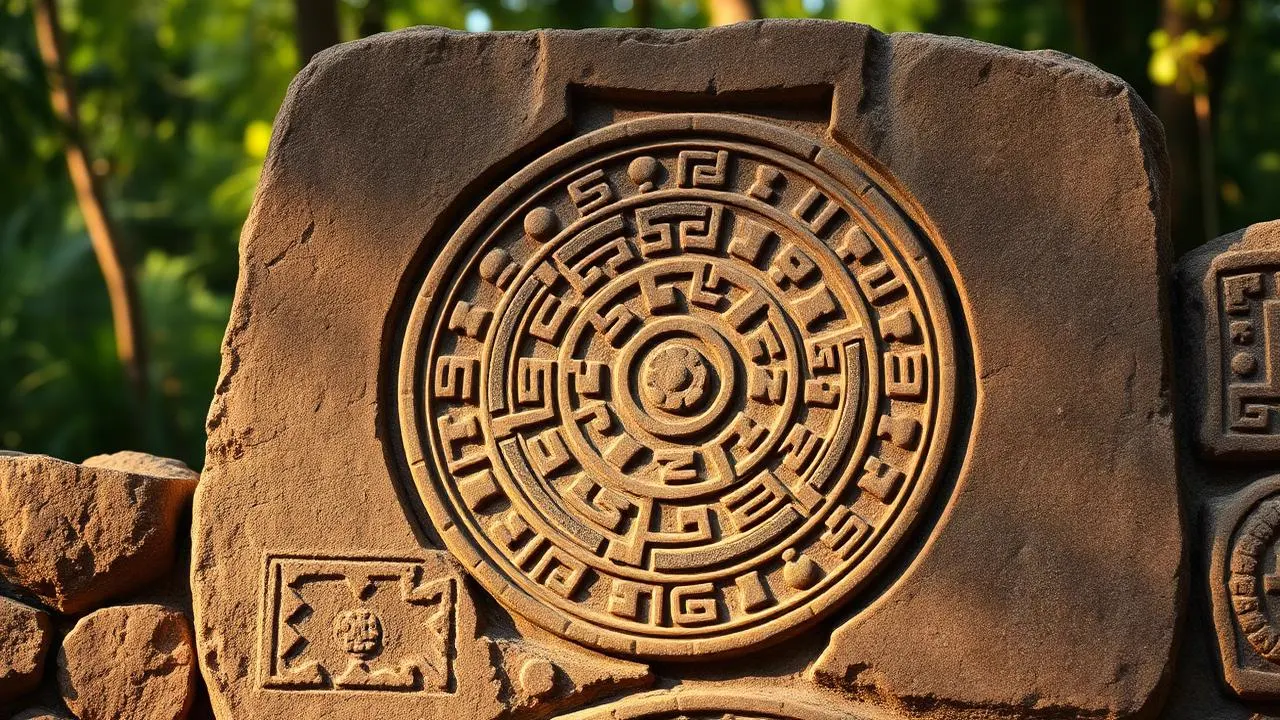
The Mayan calendar is not one calendar but three counts running at the same time: the 260-day Tzolk'in ritual round, the 365-day Haab' solar year, and the Long Count that fixes any date in absolute time. Together they let Maya scribes place an event to the exact day across thousands of years.
If you are heading to the ruins, this system is the key that turns a pile of limestone into a readable machine. The step counts, panel counts and sightlines you will walk past are calendar statements. This guide explains each count in plain language, then shows where the mathematics is physically built into the site.
What Is the Mayan Calendar and Why Three Counts?
The Mayan calendar system tracks three independent cycles because each answered a different question. The Tzolk'in answered what a day meant spiritually. The Haab' answered where the year stood agriculturally. The Long Count answered when an event happened in history, with no ambiguity, which mattered for dynastic claims carved in stone.
Every Maya city used the same framework, from Palenque to Copán to Chichen Itza. Dates were interchangeable across the Maya world in a way European kingdoms would not achieve for another thousand years. The system survived the collapse of the Classic cities and parts of it are still counted today in highland Guatemala.
The Tzolk'in: How the 260-Day Sacred Round Works
The Tzolk'in pairs the numbers 1 through 13 with twenty named days, Imix, Ik', Ak'b'al and so on. Both wheels advance together, so 1 Imix is followed by 2 Ik', then 3 Ak'b'al. Because 13 and 20 share no common factor, a pairing repeats only after 260 days.
Each of the twenty day-names carried a personality. A child born on a Kimi day was thought to have a different destiny than one born on Kawak. Priests known as day-keepers read the Tzolk'in to choose wedding dates, war dates and planting dates. This is the count still kept by Maya communities in Guatemala.
The Haab': The 365-Day Solar Year and Its Five Unlucky Days
The Haab' divides the year into 18 months of 20 days each, giving 360, then adds a five-day tail called Wayeb'. Those five days were considered dangerous, a gap when the boundary between worlds thinned. People avoided travel, left hair uncut and kept ceremonies to a minimum until the new year opened.
| Count | Length | Purpose | Still used today |
|---|---|---|---|
| Tzolk'in | 260 days | Ritual, divination, naming | Yes, in highland Guatemala |
| Haab' | 365 days | Agricultural and civil year | Rarely |
| Calendar Round | 52 years | Combined Tzolk'in + Haab' cycle | Ceremonial only |
| Long Count | Open-ended | Absolute historical dating | Scholarly use |
The Long Count: How the Maya Dated Monuments to the Exact Day
The Long Count counts days elapsed since a mythic zero point corresponding to 11 August 3114 BC. It stacks five units: k'in (1 day), winal (20 days), tun (360 days), k'atun (7,200 days) and b'ak'tun (144,000 days). A date like 9.16.0.0.0 reads as a precise day, comparable to a modern timestamp.
Why 2012 Was a Rollover, Not an Ending
On 21 December 2012 the Long Count reached 13.0.0.0.0, closing a b'ak'tun cycle. Maya monuments at Palenque already referenced dates in the year 4772, which makes an intended apocalypse impossible. The 2012 phenomenon was built almost entirely by twentieth-century authors, not by Maya sources.
Where You Can See Calendar Mathematics Built Into Chichen Itza
El Castillo is the clearest calendar in stone anywhere in the Maya world. Four stairways of 91 steps plus the summit platform equal 365, the Haab' year. Each face carries 52 recessed panels, matching the Calendar Round. Nine terraces split by each stairway read as 18, the number of Haab' months.
The pyramid is described in full in the Kukulcan Pyramid at Chichen Itza guide, the deity behind the design has his own page on Kukulkan, the feathered serpent god, and the Venus tables were tracked from the El Caracol observatory. For the dated inscriptions in context, read the history of Chichen Itza.
Reading a Maya Date on Site: A Practical Walkthrough
Carved dates usually open with an Initial Series introducing glyph, then the five Long Count positions stacked vertically, then the Tzolk'in day, then the Haab' day. At the Great Ball Court at Chichen Itza the ring inscription is read this way and yields a dedication around AD 864, one of the firmest dates at the site.
Most visitors walk past these carvings without a guide and see decoration. With a certified guide, the same panel becomes a dated historical record. That difference is the single biggest reason travelers rate a guided visit above a self-drive day.
Ready to see the calendar in stone with someone who can read it? Compare formats on the Chichen Itza tours hub, or start from your hotel with a Chichen Itza tour from Cancun.
Continue reading
Related guides with the same travel intent.
Frequently Asked Questions
How does the Mayan calendar work?
The Mayan calendar runs three counts at once. The Tzolk'in cycles 13 numbers against 20 day-names for a 260-day ritual year. The Haab' runs 18 months of 20 days plus a 5-day period for 365 days. The Long Count records absolute days since a fixed start date, which is how the Maya dated monuments.
Why is the Mayan calendar 260 days?
The 260-day Tzolk'in matches the human gestation period and the interval between zenith passages of the sun in the southern Maya lowlands. It also equals 13 times 20, the two most sacred numbers in Maya thought. It was the ritual calendar used for naming children, timing ceremonies and divination.
Did the Mayan calendar predict the end of the world in 2012?
No. December 21, 2012 marked the end of the 13th b'ak'tun of the Long Count, the equivalent of an odometer rolling over. Maya inscriptions themselves reference dates thousands of years past 2012. No ancient text describes an apocalypse tied to that day, the idea was a modern invention.
Is the Mayan calendar more accurate than ours?
For the solar year, no. The Haab' has no leap-day correction, so it drifts about a quarter day per year. Where Maya astronomy excelled was in the Venus tables of the Dresden Codex, accurate to roughly two hours over 500 years, and in eclipse prediction.
Can you see the Mayan calendar at Chichen Itza?
Yes, encoded in architecture rather than displayed as a stone disc. El Castillo has 91 steps per side plus the top platform, totalling 365, and 52 wall panels per face matching the 52-year Calendar Round. El Caracol observatory aligns to Venus extremes, the planet the Maya tracked most carefully.
What is a Calendar Round?
A Calendar Round is the 52-year cycle produced when the 260-day Tzolk'in and 365-day Haab' run together. A given Tzolk'in and Haab' date pair repeats only once every 18,980 days, about 52 solar years, which the Maya treated as a full lifetime cycle.