
El Caracol Chichen Itza: A Complete 2026 Guide to the Maya Observatory

Inside El Caracol, the round Maya observatory at Chichen Itza, Venus sightlines, the spiral staircase, who built it, the Dresden Codex link, 2026 access rules, and how it compares to El Castillo.
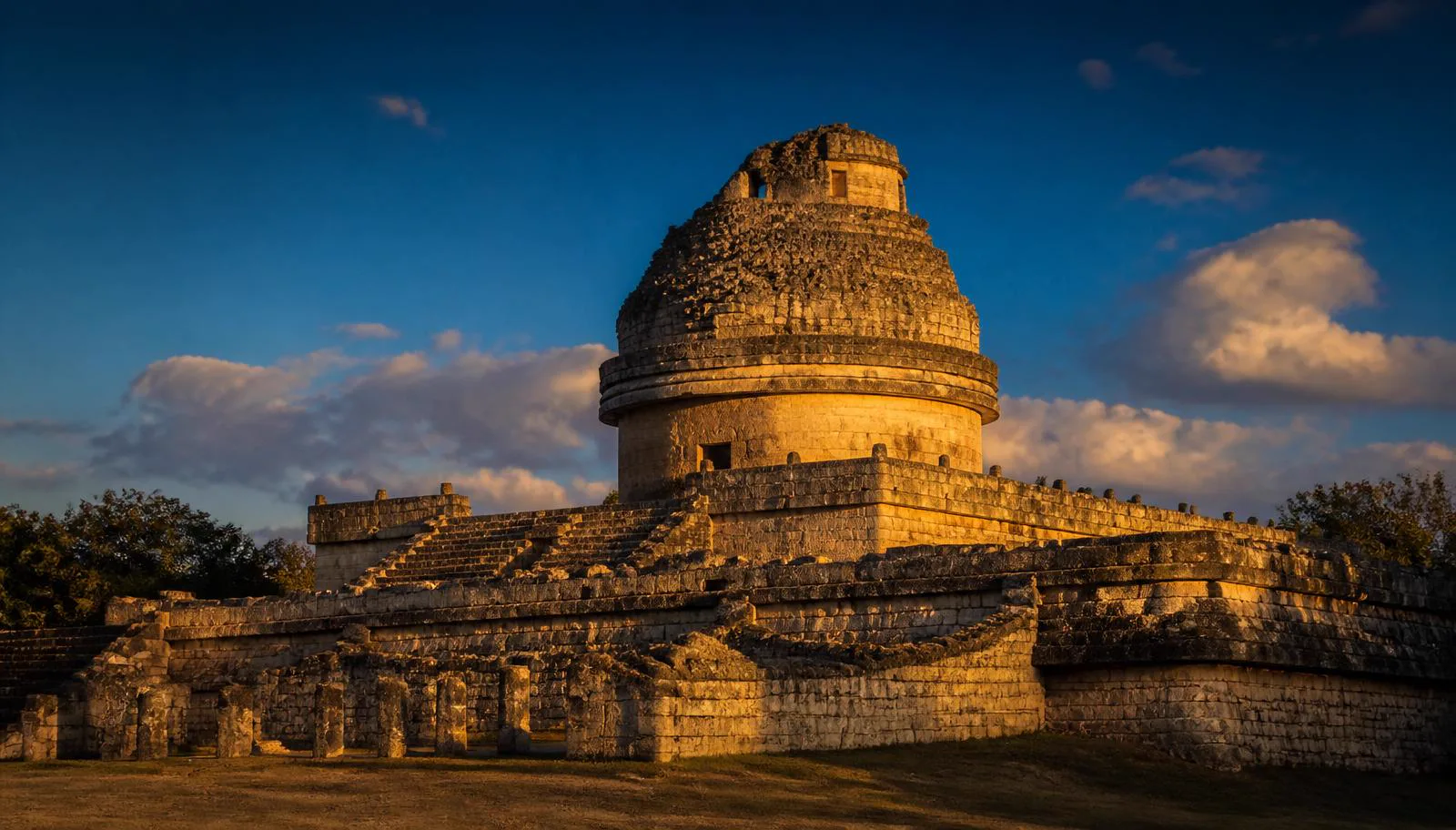
El Caracol at Chichen Itza is the round Maya observatory whose upper-tower windows and platform edges align with Venus, the equinox sunset and both solstices. Built in stages between roughly 800 and 1000 AD by the Itza Maya, its Spanish name means the snail and refers to the spiral staircase inside the upper drum. The building is the strongest surviving evidence that Chichen Itza's astronomers watched the sky as a state science.
This guide covers what El Caracol actually is, why the Spanish named it after a snail, its location inside the archaeological zone, when and by whom it was built, its unusual round-tower architecture, what the Maya observed from it, the exact 27.5° Venus alignment of the facade and window sightlines, its connection to the Dresden Codex Venus Table, how it compares with El Castillo, the strict 2026 access rules, and the best photography angle. Dates and figures follow Anthony Aveni's 1975 Science measurements, INAH's on-site signage and current Mayanist scholarship.
What Is El Caracol at Chichen Itza?
El Caracol at Chichen Itza is a two-tier stone complex made of a large lower platform, a smaller upper platform, and a round tower rising 12.5 metres above the upper platform's floor. Inside the tower, a spiral staircase coils up to a small chamber whose partly ruined walls once held four narrow windows. Three of those windows survive, each cut through more than a metre of stone, giving them the character of viewing shafts rather than casual openings.
Function separates El Caracol from every other structure at the site. The Great Ball Court is a stadium, El Castillo is a solar calendar in pyramid form, the Sacred Cenote is a ritual well; El Caracol is a purpose-built astronomical station. Its architecture makes no sense as a temple, the round drum is too small to hold ceremonies, the windows are too narrow to be doors, but it makes complete sense as a place to stand and mark where Venus and the sun rise and set.
Why Is It Called El Caracol? The Meaning of the Snail
El Caracol means the snail in Spanish, and the name comes from the spiral staircase that winds up through the interior of the round tower. Sixteenth-century Spanish clergy travelling through Yucatan saw the coil of stone treads inside the upper drum, called it caracol for its resemblance to a snail's shell, and the label stuck. The Maya name for the building is not preserved in any surviving codex or inscription.
The spiral itself is a tight helix of stone steps set into a solid core, roughly 1 metre wide, ascending from the base of the tower to the observation chamber. It is the earliest surviving spiral staircase in Mesoamerica. Whether the coil carried symbolic meaning to the Itza, snail imagery is associated with wind, breath and emergence in later Maya cosmology, remains argued. What is not argued is that the stair exists because straight steps could not reach the round chamber inside a small drum.
Where Is El Caracol Located Inside the Archaeological Zone?
El Caracol stands in the southern precinct of Chichen Itza, roughly 500 metres south of El Castillo and 80 metres north of Las Monjas (the Nunnery Group). Walking the standard route from the main west entrance, you reach it after El Castillo, the Great Ball Court, the Temple of the Warriors and the Sacred Cenote, usually the fifth or sixth major stop. GPS coordinates: 20.6795° N, 88.5688° W.
The southern precinct is often called Old Chichen because it holds the site's earliest surviving buildings, Las Monjas, the Iglesia, the Akab Dzib, most of them in the Puuc architectural style typical of southern Yucatan before the Terminal Classic. El Caracol sits at the northern edge of this precinct, physically and stylistically bridging the older Puuc south and the later international-style buildings around the Great Plaza. For a full walking plan of every monument on-site, the Chichen Itza site plan maps the standard route.
When Was El Caracol Built and Who Built It?
El Caracol was built by the Itza Maya in three architectural phases between roughly 800 and 1000 AD, during the Terminal Classic and early Postclassic periods. Ceramic stratigraphy from the Carnegie Institution excavations in the 1930s dates the lower platform to around 800 AD, the upper platform and the base of the round tower to around 900 AD, and the tower's observation chamber and windows to the late 900s. Every phase serves the astronomical function; each added platform re-frames a new set of sightlines.
A hieroglyphic stele found on the upper platform carries a Long Count date long read as 10.2.0.0.0 (roughly 906 AD). Susan Milbrath and Carlos Peraza Lope (2016), in a revised reading of Dresden Codex page 24 that anchors the codex's Venus Table to a specific historical correction, argue that the observations recorded there were made from El Caracol beginning around 864 AD. On either reading the tower is a Terminal Classic building tied to an Itza dynasty that also commissioned El Castillo, the Great Ball Court and the Temple of the Warriors within the same 200-year window.
How Was El Caracol Built? Round Tower on a Double Platform
El Caracol's architecture stacks a round tower on a rectangular substructure, a form almost unique in Maya architecture. The lower platform measures 52 by 67 metres and rises about 6 metres. On top of it sits the smaller upper platform, 30 by 25 metres. From the upper platform's centre rises the round drum, 11 metres in diameter at the base and about 12.5 metres tall, with an interior stone core wrapped by a concentric outer wall. The spiral staircase runs between the core and the outer wall.
| Element | Measurement | Note |
|---|---|---|
| Lower platform | 52 × 67 m, ~6 m tall | Oldest phase, ~800 AD |
| Upper platform | 30 × 25 m | Added ~900 AD |
| Round tower diameter | 11 m at base | Cylinder tapers slightly upward |
| Round tower height | ~12.5 m | Above upper-platform floor |
| Total height above ground | ~22.5 m | Ground to top of surviving dome |
| Surviving upper windows | 3 of original 4 | Each ≥1 m deep, viewing shafts |
| Facade orientation | 27.5° north of west | Aligns with Venus northern extreme |
Round buildings are rare across the Maya world. Only a handful survive across the Yucatan Peninsula, Uxmal, Mayapán, and Cuca among them, and every confirmed example is associated with Venus worship. The round form is not decorative: a rectangular wall cannot easily hold multiple narrow viewing shafts pointing at widely different azimuths, because each shaft would meet the outer wall at a different angle and geometry. A cylinder solves the problem, every window points radially outward, so any azimuth is available.
What Did the Maya Observe from This Ancient Observatory?
From this ancient observatory the Maya tracked Venus above everything else. Yucatec Maya astronomers called Venus Noh Ek, the Great Star, and treated it as a war and kingship omen whose 584-day synodic cycle governed campaign dates, coronations and public sacrifice. El Caracol's alignments target Venus's four extreme setting positions, the two northern extremes reached during morning-star and evening-star cycles, and the two southern extremes, with a precision that requires generations of naked-eye observation to plot.
Anthony Aveni, Sharon Gibbs and Horst Hartung published the definitive study in Science in June 1975. They measured every wall edge, platform corner and window shaft with theodolite, then projected the resulting azimuths against the sky of the 9th and 10th centuries using precession-corrected star charts. The paper concluded that the number of astronomical alignments in the building, Venus extremes, equinox sunset, both solstice sightlines from platform corners, and lunar standstill positions, is far too many to be coincidence.
How Do the Windows and Facade Align with Venus?
El Caracol's Venus alignment runs through both the outer facade and the interior window shafts. The grand west-facing staircase of the upper platform is oriented 27.5° north of due west, within 1° of the northern extreme setting point of Venus as seen from Chichen Itza's latitude in the 9th century. Standing at the top step and looking straight down the axis, an observer would see Venus set on the horizon at its most northerly evening-star appearance, roughly once every eight years.
Inside the upper tower, the three surviving windows carry the finer alignments. Window 1 (western) frames Venus's extreme southern setting position. Window 2 (southwest) frames the equinox sunset, the same twice-yearly moment that shadows El Castillo's north staircase. Window 3 (south) frames the summer solstice sunset. A diagonal drawn between the northeast and southwest corners of the lower platform aligns with the summer solstice sunrise and the winter solstice sunset, adding two more independent solar sightlines to the same building.
Does El Caracol Connect to the Dresden Codex Venus Table?
Yes, El Caracol is the most plausible physical source of the observations recorded in the Dresden Codex Venus Table. The Dresden Codex is one of only four surviving pre-conquest Maya books, produced in Yucatan around the 12th century. Pages 24 through 29 hold a Venus Table, a 584-day synodic-cycle almanac calibrated across 104 years, that predicts Venus's morning-star rise dates with an accuracy of about one day per 6,000 years.
Milbrath and Peraza Lope's 2016 reading of Dresden page 24 identifies the Long Count dates that anchor the table's historical correction, and those dates fall within Chichen Itza's Terminal Classic peak. Reaching accuracy that high on Venus's synodic cycle requires roughly 300 continuous years of naked-eye observation from a fixed station. El Caracol, with its stone-cut Venus sightlines, its Terminal Classic construction date and its position at the political capital of Yucatan at exactly that moment, is the only surviving building that fits every requirement.
How Does El Caracol Compare to El Castillo?
El Caracol and El Castillo both encode Maya astronomy, but they answer different questions. El Castillo is a solar calendar in pyramid form, 365 steps for the solar year, four staircases for the seasons, an equinox shadow serpent on the north face. It reports the sun's yearly cycle to the public in stone. El Caracol is a working observation station: three narrow windows, a spiral stair, a Venus-aligned facade and a corner-to-corner solstice diagonal. It records the data the calendar was built from.
The two buildings also differ physically in every direction. El Castillo is 30 metres tall on a 55-metre square base with four identical staircases and no interior windows; El Caracol is 22.5 metres tall total, cylindrical on a rectangular platform, and its function lives inside the tower rather than on its exterior. Both were built inside the same 200-year Itza building programme, but by different specialist workshops, solar priest-architects at one, Venus astronomers at the other. For the full technical breakdown of El Castillo's dimensions, equinox shadow and inner pyramid, see the Pyramid of Kukulcán.
Can You Go Inside El Caracol in 2026?
You cannot go inside El Caracol in 2026. INAH closed the interior spiral staircase and the upper observation chamber in the 1980s after decades of visitor traffic damaged the stone treads and the narrow window shafts. Every year since, the closure has been renewed. The exterior of both platforms and the base of the round tower remain visible from a walking path that circles the structure. A rope line keeps foot traffic roughly 2 metres from the platform's lower stairs.
Photography from the walking path is allowed with handheld gear; tripods and drones require separate INAH permits and are usually refused for El Caracol due to conservation status. The closure applies year-round, including the spring and autumn equinoxes. For a full list of what is open and what is closed monument by monument, the Chichen Itza schedule guide keeps the current rules mapped.
Best Angle and Time to Photograph El Caracol
The best angle on El Caracol is from the southwest corner of the lower platform at roughly 4:00 to 4:30 PM, when late-afternoon side-light rakes across the round drum and picks out the seam of the spiral staircase against the outer wall in visible shadow. Morning light between 8:00 and 9:00 AM lights the east face cleanly but flattens the tower's cylindrical volume. Overhead midday sun kills the depth of the round form and the shadow-line of the platforms.
Round drum against sky
A 35–50mm focal length from about 20 metres southwest of the platform base isolates the round tower against clean sky and holds both platforms in the same frame. Wait for a partly-clouded sky rather than a flat blue one, clouds behind the drum give the cylinder a scale reference the eye can read.
Window shafts detail
A 200mm lens or a 3× to 5× smartphone telephoto from the same southwest position frames the three surviving upper-tower windows individually. Time the shot for when the sun angle carves the deep window shafts into visible relief, usually 4:15–4:45 PM in dry season. For a full breakdown of angle, light and lens choices across every monument on-site, the Chichen Itza photography walks through each pyramid, plaza and cenote.
Planning a Visit to El Caracol
El Caracol reads better on-site once you know the alignments, the 27.5° facade toward the northern extreme of Venus, the three window shafts pointing at Venus's southern extreme, the equinox sunset and the summer solstice sunset, the corner diagonal marking both solstices, and the Terminal Classic construction window that made the Dresden Codex Venus Table possible. Standing at the southwest corner with those figures in mind is a different building than standing there without them. Itza Quest operates Chichen Itza day tours from Cancun, Playa del Carmen, Tulum and Merida with certified INAH guides who can walk you through every alignment on the platform.
Continue reading
Related guides with the same travel intent.
Frequently Asked Questions
What does El Caracol mean and why is it called that?
El Caracol means the snail in Spanish. The name refers to the spiral staircase that coils inside the upper tower, first noted by 16th-century Spanish observers who saw its resemblance to a snail's shell. The Maya name for the building is unknown; caracol is a colonial nickname that stuck because the interior stair is the structure's most distinctive feature.
Was El Caracol really an observatory?
Yes, El Caracol is the strongest candidate for a purpose-built Maya observatory. Anthony Aveni, Sharon Gibbs and Horst Hartung's 1975 Science paper measured its windows and platform edges and found sightlines aligned with Venus's extreme northern and southern positions, spring and autumn equinox sunsets, and the summer and winter solstice. The number of intentional astronomical alignments in one small building is difficult to explain any other way.
Can you go inside El Caracol in 2026?
You cannot go inside El Caracol in 2026. INAH closed the interior spiral staircase and the upper tower to visitors in the 1980s for conservation, and the closure has held every year since. The exterior platforms and the base of the round tower are visible from a walking path that circles the structure. Approaching within roughly 2 metres of the platform base is allowed for photography; entering the tower is not.
When was El Caracol built?
El Caracol was built in stages between roughly 800 and 1000 AD, during the Terminal Classic period. The lower platform is the oldest element, dated by ceramic sequence to around 800 AD. The round tower and upper platform were added later, with a hieroglyphic stele on the upper platform bearing a date most commonly read as 906 AD. Some scholars, using a revised reading of the Dresden Codex Venus Table preface, argue for an earlier tower date of 864 AD.
How does El Caracol align with Venus?
El Caracol's front staircase faces 27.5 degrees north of west, an almost exact match for Venus's northern extreme setting position on the horizon. Two of the three surviving upper-tower windows point at Venus's southern extreme setting and at the equinox sunset. A diagonal drawn between the northeast and southwest corners of the lower platform aligns with the summer solstice sunrise and the winter solstice sunset. Every alignment concentrates on Venus and the sun's turning points.
Why is El Caracol round when other Maya buildings are rectangular?
El Caracol is round because a rectangular building cannot easily hold the wide arc of horizon sightlines that Venus and the sun require. A cylinder lets narrow windows point in any azimuth without warping the wall geometry. Round Maya buildings are rare across the Yucatan Peninsula, only a handful exist, and most are also linked to Venus worship, which the Itza elite adopted intensely in the 9th and 10th centuries.