
Ek Balam: The Yucatan Mayan Ruins You Can Still Climb

Ek Balam guide 2026: the 32-meter Acropolis you can still climb, jaguar-mouth carvings, entrance fee, and how to get there from Cancun or Valladolid.
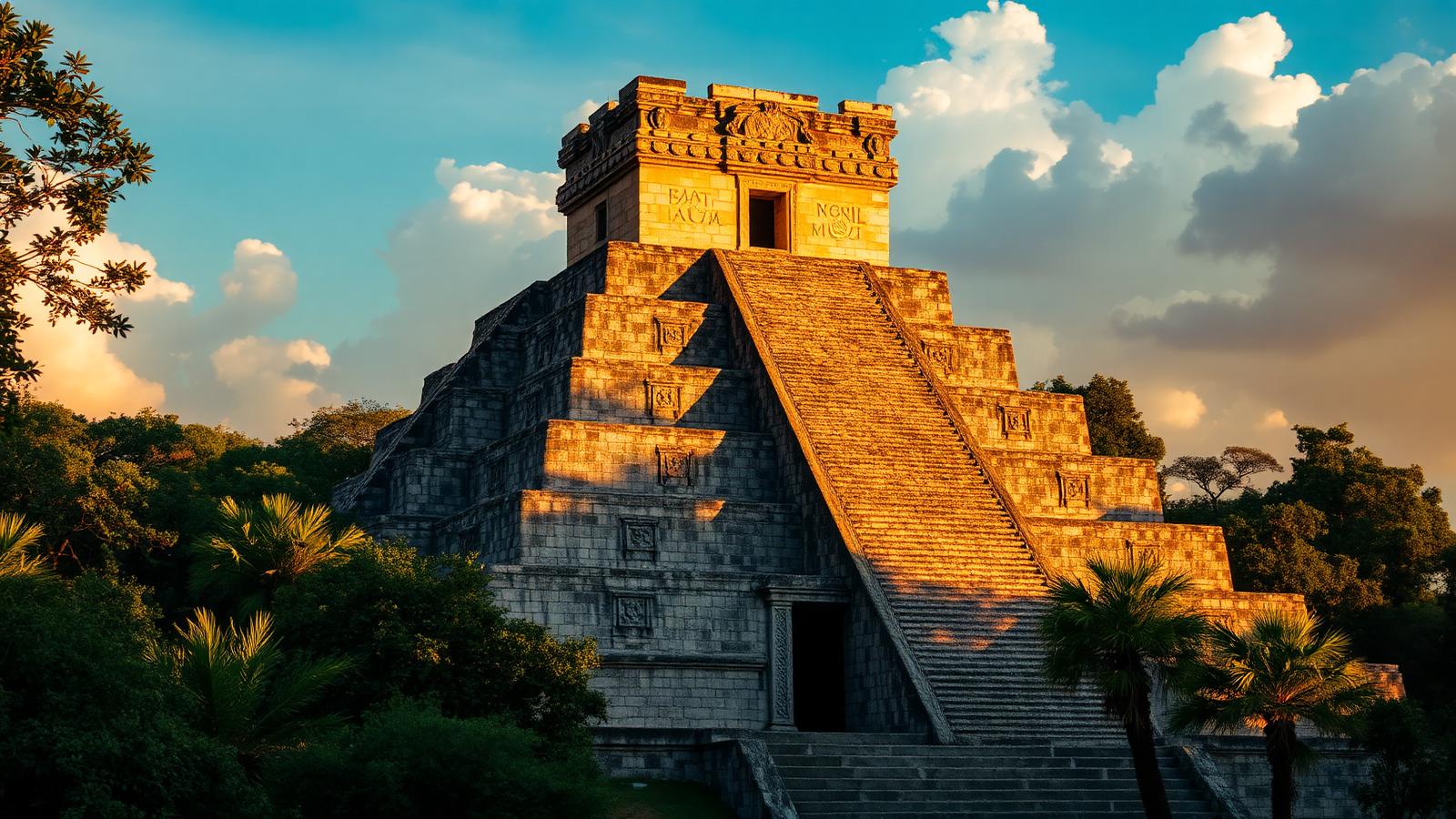
Ek Balam is a Mayan archaeological site 30 km north of Valladolid in Yucatan, Mexico, occupied from roughly 100 BC to 1200 AD and at its political peak between 700 and 1000 AD. Its 32-meter Acropolis is one of the largest pyramids in the northern Yucatan and one of the very few main pyramids in the state that visitors are still allowed to climb. The site is famous for the preserved stucco jaguar-mouth facade on the Acropolis and for the vault inscription of king Ukit Kan Le'k Tok', discovered in 1999. Ek Balam receives roughly 3% of the visitor volume of Chichen Itza 50 km southwest, so the atmosphere is quiet even in high season.
This guide covers the full picture: what the name means, where it sits, how the site compares to Chichen Itza, the Acropolis and the jaguar-mouth carvings, dynastic history, how to get there from Cancun or Valladolid, the entrance fee and hours, whether you can still climb the pyramid, and whether the site is worth adding to a Yucatan trip. Data drawn from INAH publications, the Vargas de la Peña dynastic reconstruction and 2026 site conditions.
What Is Ek Balam: Location, Size and What the Name Means
Ek Balam translates from Yucatec Maya as 'Black Jaguar', ek meaning black or dark, balam meaning jaguar. The site sits at 20.8916° N, 88.1359° W, in the municipality of Temozón, 30 kilometers straight north of Valladolid on a paved secondary road. It covers approximately 12 square kilometers, with 45 mapped monumental structures concentrated inside a defensive wall that encloses the ceremonial core, a rare feature in Mayan urbanism and evidence that Ek Balam was a fortified city.
| Feature | Measurement |
|---|---|
| Location | Temozón, Yucatan, Mexico |
| Coordinates | 20.8916° N, 88.1359° W |
| Distance from Valladolid | 30 km / 30 min north |
| Distance from Cancun | 195 km / 2h 15min west |
| Distance from Chichen Itza | 50 km northeast |
| Total area mapped | ~12 km² |
| Mapped structures | 45 monumental buildings |
| Acropolis height | 32 m (105 ft) |
| Acropolis width | 158 m at base |
| Occupation range | ~100 BC – 1200 AD |
| Peak period | 700 – 1000 AD |
| UNESCO status | Tentative list (not inscribed) |
Ek Balam Ruins vs Chichen Itza: Why the Smaller Site Wins on Atmosphere
Direct comparison first. Chichen Itza is larger, more famous and archaeologically richer, it is UNESCO-inscribed, a New Seven Wonder and receives 2.5 million visitors a year. The Ek Balam ruins receive an estimated 70,000 to 90,000 visitors a year, roughly 3% of Chichen Itza's volume. On any given morning outside a national holiday you may share the entire archaeological zone with fewer than 100 other people. That density gap is the single biggest reason travelers who see both consistently rate Ek Balam higher for atmosphere and photography.
| Feature | Ek Balam | Chichen Itza |
|---|---|---|
| Annual visitors | ~80,000 | ~2,500,000 |
| Main pyramid height | 32 m (climbable) | 30 m (no climbing) |
| UNESCO status | Tentative | Inscribed 1988 |
| Wonders of the World | No | New Seven, 2007 |
| Site atmosphere | Quiet, jungle-close | Crowded, exposed |
| Guided tour required | No, self-guide works | Strongly recommended |
| Time needed on-site | 1.5–2 hours | 2.5–4 hours |
| Nearby swimmable cenote | Cenote X'Canché (1 km) | Cenote Ik Kil (3 km) |
| Foreign entrance fee 2026 | ~566 MXN | ~697 MXN |
The classic pairing is to visit both on the same day, or across two consecutive days from Valladolid Yucatán. Chichen Itza at sunrise (arriving at the 8 AM opening when Best time of year for Chichen Itza can be avoided), then Ek Balam the following afternoon when there is no crowding competition on the Acropolis climb. A combined Chichen Itza and Ek Balam tour with private transport and guide covers both ruins plus a cenote in a single long day from the Riviera Maya.
The Acropolis: Standing Tall Among Yucatan Pyramids
The Acropolis is the main structure at Ek Balam and one of the largest single buildings the ancient Maya built anywhere. It measures 158 meters long by 60 meters wide at the base and rises 32 meters through six terraced levels, taller than El Castillo at Chichen Itza by two full meters, and among the tallest of all Yucatan pyramids. Unlike El Castillo, which is a single-purpose radial temple, the Acropolis is a compound structure: royal palace, ceremonial platform, funerary complex and lookout post stacked into one massive terraced mountain.
On the fourth level, halfway up the pyramid, is the feature that puts Ek Balam in every serious book on Maya art: a stucco monster-mouth doorway called El Trono (The Throne), preserving a life-sized jaguar-monster face with fangs, eye sockets and a curled upper lip that frames the doorway. The stucco is the original 8th-century plaster, protected for 1,200 years by a later Maya construction that buried it and only re-exposed in 1998. It is the best-preserved monumental Maya stucco facade in the entire Yucatan.
The architectural contrast with El Castillo reveals two different Maya philosophies, a radial calendrical temple versus a palace-pyramid funerary complex. For the full dimensions and calendrical symbolism of El Castillo see the Kukulcán pyramid guide.
Ek Balam Yucatan History: Kings, the Vault Inscription and Decline
Ek Balam Yucatan was ruled by a documented dynasty of at least six kings during its 700–1000 AD peak. The most important was Ukit Kan Le'k Tok', whose reign is dated to approximately 770 to 802 AD and who commissioned most of the visible Acropolis architecture. His tomb was located inside Room 49 on the fourth level of the pyramid, the same level that carries the stucco jaguar-mouth facade, and contained more than 7,000 associated grave goods including ceramic vessels, jade jewelry, obsidian blades and painted textiles.
Directly above the tomb, painted onto the interior vault of the burial chamber, is the Ek Balam vault inscription, 96 hieroglyphs in painted red and black recording the king's death, his royal titles ('K'uhul Talol Ajaw', divine lord of Talol) and the ritual actions of his successor. Discovered in 1999 by INAH archaeologist Leticia Vargas de la Peña, it is the single longest painted glyphic text known from the northern Maya lowlands and rewrote what scholars thought they knew about political power in Terminal Classic Yucatan.
Ek Balam declined after 1000 AD, the same multi-decade drought horizon that reconfigured the entire northern Yucatan and pushed every other Maya capital out of power. For the same environmental collapse seen from the sister site to the southwest, see the history of Chichen Itza.
How to Get to Ek Balam from Cancun, Valladolid and Tulum
Ek Balam is one of the closest major Mayan ruins near Cancun, 195 km west, a 2 hour 15 minute drive on the 180D toll road, actually 15 minutes closer to Cancun than Chichen Itza. From Valladolid the site is 30 km straight north on the paved 295 secondary road, a 30-minute drive. From Tulum the route runs Tulum → Coba → Valladolid → Ek Balam, about 2 hours 30 minutes. From Playa del Carmen add 45 minutes to any Tulum figure. Mexico Ek Balam route markers are consistent, every turn is signed once you leave the toll road at Valladolid.
| Origin | Distance | Drive time | Route |
|---|---|---|---|
| Valladolid | 30 km | 30 min | 295 Norte via Temozón |
| Chichen Itza | 70 km | 1 h 10 min | 180 → Valladolid → 295 |
| Cancun airport | 195 km | 2 h 15 min | 180D → Nuevo Xcán → Valladolid → 295 |
| Cancun hotel zone | 215 km | 2 h 35 min | 180D via bypass |
| Playa del Carmen | 255 km | 3 h 00 min | 307 → 180D → Valladolid |
| Tulum | 230 km | 2 h 30 min | Coba → Valladolid → 295 |
| Merida | 160 km | 1 h 55 min | 180D east |
The practical logistics of a Cancun to Ek Balam day trip are identical to Chichen Itza: 6:30 AM hotel pickup, on-site before 9:30 AM, two hours walking the site, drive back via Valladolid before sunset. Exact drive times, tolls and fuel numbers are covered in the how far is Chichen Itza from Cancun guide, swap the last 40 km. For door-to-door service with private transport and a certified guide, a Chichen Itza tour from Cancun extends easily to Ek Balam on request.
Ek Balam Entrance Fee, Opening Hours and Cenote X'Canché
Ek Balam charges two separate fees at two separate windows, exactly like Chichen Itza. In 2026, foreign visitors pay 100 MXN federal INAH admission plus 466 MXN state CULTUR fee, a combined 566 MXN, roughly $30 USD at current exchange. Mexican nationals pay a reduced total and enter free on Sundays with valid identification. Children under 13 enter free at both windows. Opening hours are 8:00 AM to 5:00 PM, last entry at 4:00 PM. Ek Balam is open every day of the year including Sundays and holidays.
One kilometer east of the Ek Balam archaeological zone is Cenote X'Canché, an open cenote with a 15-meter drop, turquoise water, hanging tree roots and a wooden staircase descending to a swimming platform. Entry costs 150 MXN separate from the ruins ticket and includes life jacket loan. The cenote is managed by the local Mayan cooperative and is the standard afternoon stop after climbing the Acropolis. Bicycle rentals and short jungle taxis run continuously from the Ek Balam parking lot to the cenote.
If swimming is a priority and there is only time for one cenote on the trip, Ik Kil cenote beside Chichen Itza and X'Canché beside Ek Balam are comparable, Ik Kil is more famous and more crowded, X'Canché is quieter and more natural.
Can You Still Climb Ek Balam? What the Rules Are in 2026
Yes, as of 2026 the main Acropolis pyramid at Ek Balam is still open to climb, and this is the single defining reason many travelers choose to visit. Climbing has been permitted continuously since the site opened to visitors in 2000 and there is no announced closure. The staircase runs the full front face of the pyramid: 106 steps, each about 30 cm deep and 20 cm high, worn but stable. A knotted rope runs down the center as a hand guide. Round trip up and down takes 20 to 30 minutes.
Rules for climbing: no strollers or bulky bags on the staircase, no drones over the pyramid, no consuming food or drink on the terraces, and no climbing during electrical storms, the summit is the highest point for kilometers. Site guards close the climb temporarily during lightning within about 5 km. The stucco jaguar-mouth facade on the fourth level is roped off, visitors pass close but cannot touch. Descent is safer facing sideways or backward on the top three steepest sections; the rope helps most on descent.
This is the strongest single argument for including Ek Balam on a Yucatan trip, it is the only large pyramid near Chichen Itza that visitors are still allowed to climb. For the wider question of whether the sister site is worth it on its own, see is Chichen Itza worth it.
Is Ek Balam Worth Visiting? Who It Suits and Who It Doesn't
For travelers who want a physical, hands-on Mayan ruins experience, climbing the pyramid, standing next to intact 1,200-year-old stucco art, walking through a low-density archaeological zone with jungle audible on all sides, Ek Balam is worth visiting more than Chichen Itza is. For travelers who want scale, fame and the checklist icon of a New Seven Wonder, Chichen Itza is the answer and Ek Balam is a supplement. Most Yucatan itineraries with more than three days on the peninsula benefit from both.
Honest recommendation: two days, two sites. Chichen Itza at sunrise one day (for the full effect with less crowding), Ek Balam mid-morning the next when the air is still cool and the Acropolis climb is comfortable. A private Chichen Itza tour with Itza Quest can be assembled to cover any combination of the two sites plus a cenote, departing from Cancun, Playa del Carmen or Tulum.
Ek Balam also sits on the road north, 90 minutes from the Rio Lagartos biosphere reserve where flamingos feed in the salt lagoons year round. Boat times, season, prices and the best light for photos are in the Rio Lagartos flamingos guide, and the two pair naturally as a two-day loop out of Valladolid.
Continue reading
Related guides with the same travel intent.
Frequently Asked Questions
What is Ek Balam and what does the name mean?
Ek Balam is a Mayan archaeological site in the northern Yucatan, Mexico, occupied roughly from 100 BC to 1200 AD and at its peak between 700 and 1000 AD. The name is Yucatec Maya and translates as 'Black Jaguar', ek meaning black or dark, balam meaning jaguar. The site covers about 12 square kilometers with a walled central core, 45 mapped structures, and the 32-meter Acropolis pyramid at its heart.
Where is Ek Balam located?
Ek Balam sits 30 km (18 miles) north of Valladolid in the state of Yucatan, Mexico. Coordinates 20.8916° N, 88.1359° W. It is 2 hours west of Cancun by Highway 180D, 30 minutes north of Valladolid, and about 50 km northeast of Chichen Itza. The nearest towns are Temozón and Hunukú. The archaeological zone is administered by Mexico's INAH.
Can you climb Ek Balam?
Yes. Ek Balam is one of the only major Mayan sites in Yucatan where visitors are still allowed to climb the main pyramid. You can walk the full 106 steps to the top of the 32-meter Acropolis, pass through the ornate Jaguar Mouth doorway on the middle terrace and stand on the summit platform. No harness, no ticket upgrade, no time limit. The climb is steep, steps are narrow and worn, but a guide rope runs down the center of the staircase.
How far is Ek Balam from Cancun?
Ek Balam is 195 km (121 miles) west of Cancun International Airport, a drive of 2 hours 15 minutes on the 180D toll road. From the Cancun hotel zone add 20 minutes. The route runs Cancun → Nuevo Xcán → Valladolid → Temozón → Ek Balam. Tolls total about 500 MXN one way. Ek Balam is 15 minutes closer to Cancun than Chichen Itza is.
How old is Ek Balam?
The site was first occupied around 100 BC in the Late Preclassic period. The monumental architecture visible today, the Acropolis, the Ball Court, the Oval Palace, was built between 700 and 1000 AD during the Late and Terminal Classic. Ek Balam declined after 1000 AD and was abandoned as a political capital by 1200 AD, though small residual occupation continued into the Postclassic. The stucco jaguar-mouth facade on the Acropolis dates to the reign of king Ukit Kan Le'k Tok', who ruled around 770–802 AD.
Is Ek Balam worth visiting?
Yes, for three reasons: you can still climb the main pyramid (banned at Chichen Itza since 2006), the stucco jaguar-mouth facade is one of the best-preserved pieces of monumental Maya art anywhere in Mesoamerica, and the site receives roughly 3% of Chichen Itza's visitor volume so the atmosphere is quiet. Ek Balam does not have Chichen Itza's scale or fame, but for atmosphere and hands-on experience it consistently rates higher on visitor reviews. Best paired with Cenote X'Canché 1 km east.
What is the Ek Balam entrance fee?
The Ek Balam entrance fee for foreign visitors in 2026 is approximately 566 MXN (about $30 USD), 100 MXN federal INAH fee plus 466 MXN state CULTUR fee, paid at two separate windows before the gate. Mexican nationals pay a reduced rate and enter free on Sundays with valid ID. Children under 13 enter free. Cenote X'Canché 1 km away has a separate 150 MXN admission.
What is the Ek Balam vault inscription?
The Ek Balam vault inscription is a hieroglyphic text painted on the inner vault of Tomb 1, on the fourth level of the Acropolis. It was discovered in 1999 by Mexican archaeologist Leticia Vargas de la Peña and dates to about 800 AD. The inscription records the death and burial of king Ukit Kan Le'k Tok' and lists his royal titles. It is the longest painted glyphic text found in the northern Maya lowlands and is one of the primary sources used to reconstruct Ek Balam's dynastic history.