
The Pyramid of Kukulcan at Chichen Itza, Mexico: Height, Design and Meaning

El Castillo, the Kukulkan pyramid and temple at Chichen Itza, stands 30 m tall in Yucatan, Mexico. Exact height, base, 365 steps, nine terraces, the 17-degree orientation and what the two names mean.
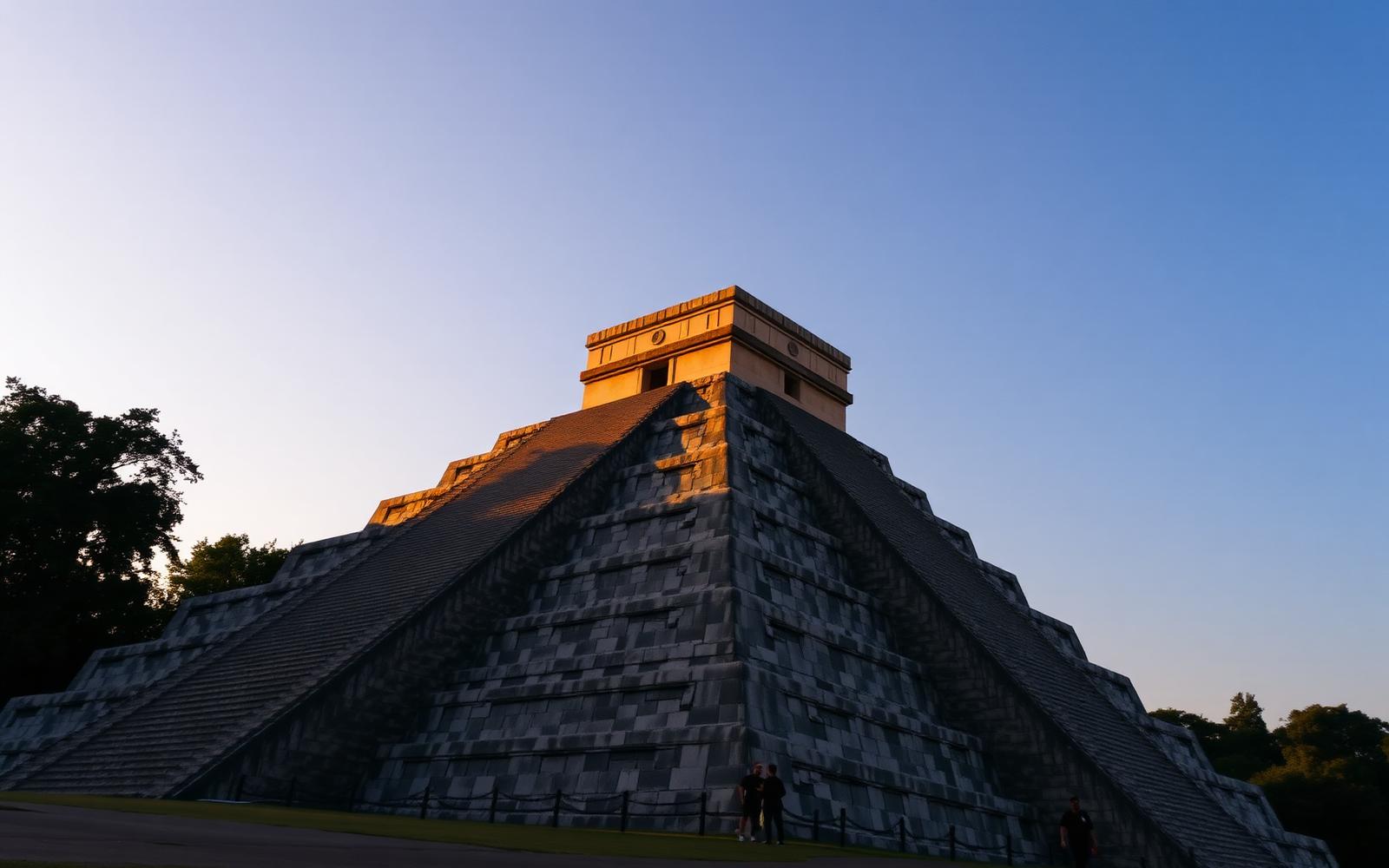
The Pyramid of Kukulcan, known as El Castillo, is a 30-meter Mesoamerican step pyramid raised by the Maya at Chichen Itza between roughly AD 800 and 1050. The pyramid carries 365 steps, nine stacked terraces and a temple to the feathered serpent deity Kukulkán at its summit.
This guide covers the structure itself: exact height and base, the two names, who raised it and when, the calendar encoded in its steps, its 17-degree orientation, the older pyramid sealed inside it, the climbing rule, the quetzal echo, and how the pyramid reads on the plaza floor. Dimensions follow INAH survey data and peer-reviewed archaeoastronomy.
What Is the Pyramid of Kukulcan at Chichen Itza?
The Pyramid of Kukulcan is a nine-tiered Mesoamerican step pyramid that worked at once as a temple, an astronomical instrument and a public ritual stage. The Maya dedicated it to Kukulkán, the feathered serpent deity the Aztecs called Quetzalcóatl. UNESCO inscribed the archaeological zone in 1988; a 2007 global public poll added El Castillo to the New Seven Wonders.
El Castillo is not the only pyramid on the site. The Osario, the High Priest's Grave and the platform under the Temple of the Warriors are all pyramidal, and the Osario repeats the same four-stair plan at half the scale. What separates the Kukulcan pyramid is that it is the tallest, it sits at the geometric center of the plaza, and every measurable feature of it encodes a unit of Mayan time.
The wider city around the pyramid, its other monuments and its place in the Maya world are set out in the guide to Chichen Itza in the Yucatan Peninsula.
Why Is It Called El Castillo and the Temple of Kukulcan?
El Castillo and the Temple of Kukulcan are two names for one structure. Kukulkan temple describes the small shrine crowning the nine terraces, the part that actually held ritual; El Castillo, Spanish for the castle, is what sixteenth-century Spanish observers called the whole mass when they mistook it for a fortress. Archaeologists avoid both and use the survey code 5B18.
Spelling varies because the name crossed three writing systems. Kukulkán is the Yucatec Maya form, Kukulcán the hispanized spelling, and Quetzalcóatl the Nahuatl equivalent carried by central Mexican contact. All three point to the same feathered serpent, so a search for the Kukulkan temple, the Kukulcan pyramid or El Castillo lands on this one building at Chichen Itza.
How Tall Is El Castillo? Height, Base and Exact Dimensions
El Castillo rises 24 meters (79 ft) to the temple base and 30 meters (98 ft) including the summit temple. Each of the four sides measures 55.3 meters (181 ft) at ground level, giving a footprint near 3,060 square meters. Nine terraces stack in near-square plan, and every side carries an identical 91-step staircase between carved balustrades.
| Feature | Measurement |
|---|---|
| Height (to temple base) | 24 m (79 ft) |
| Height (with temple) | 30 m (98 ft) |
| Base, side length | 55.3 m (181 ft) |
| Number of stacked terraces | 9 |
| Staircases | 4 (one per side) |
| Steps per staircase | 91 |
| Total steps + top platform | 365 |
| Recessed panels per face | 52 |
| Orientation offset from true north | 17° east of north |
| Construction material | Limestone with lime-mortar core |
Scale is worth putting in context. El Castillo is roughly a third the height of the Pyramid of the Sun at Teotihuacan and far smaller in volume than the Great Pyramid of Cholula, yet it is the most precisely aligned of the three. Mayan builders traded mass for accuracy: the limestone blocks are modest, the geometry is not.
Where Does the Kukulcan Pyramid Stand in the Yucatan?
The Kukulcan Pyramid stands in the Chichen Itza archaeological zone, municipality of Tinum, in the northern interior of Yucatan state, southeast Mexico, at 20.6829° N, 88.5686° W. The site lies 200 km west of Cancun, 120 km east of Merida, 42 km west of Valladolid and 3 km east of Piste, the nearest town with hotels.
Almost every visitor arrives from the coast as a day trip on Highway 180D. Exact drive times are in how far is Chichen Itza from Cancun, and the site layout with the pyramid at its center is drawn in the Chichen Itza site map. To arrive early without driving, a private Chichen Itza tour from Cancun handles the door-to-door logistics.
Who Built the Chichen Itza Pyramid, and When Was It Finished?
The Maya of Chichen Itza built the pyramid in two campaigns. An inner, smaller pyramid belongs to the Terminal Classic, around AD 800–900; the larger outer shell standing today was raised over it roughly a century later, and radiocarbon dates from interior wood beams place completion in the AD 900–1050 range.
No architect is named. Mayan monumental construction was commissioned by the ruling lineage and directed by the priesthood, and the surviving glyphic record at Chichen Itza credits offices and dynasties rather than designers. That is a real difference from Egypt, where builders and overseers often signed their work in quarry marks.
The full city timeline, who the Itza were and why the site declined are covered in the Chichen Itza Maya history guide.
Why Was the Mayan Pyramid Built? Temple, Stage and Sky
The Mayan pyramid was built for three fused purposes: a temple housing Kukulkán, a raised stage that let ritual be seen by thousands standing in the plaza, and an instrument that kept the ceremonial year visible in stone. Nine terraces echoed the nine levels of Xibalbá, the Mayan underworld the dead were believed to descend through.
The plaza design matters as much as the building. The pyramid sits on an open, paved square with no obstructing structures on the north and west, so a crowd of several thousand could watch the summit from any angle. Few Mesoamerican temples are staged this openly; at Tikal and Palenque the pyramids rise inside enclosed courts visible only to the elite.
How Do the 365 Steps Encode the Mayan Calendar?
The 365 steps of El Castillo count the days of the Haab', the Mayan solar year: four staircases of 91 steps, plus the top platform as the final step. The nine terraces are each split by a staircase into two, producing 18 panels per side that match the 18 named months of the Haab'.
- 365 steps — the days of the Haab' solar year.
- 18 panels per side — the eighteen 20-day Haab' months.
- 52 recessed panels per face — the 52-year Calendar Round.
- 9 terraces — the nine levels of Xibalbá.
- 4 staircases — the four world directions, each with its color and deity.
The 52-year count appears because the 365-day Haab' and the 260-day sacred Tzolk'in realign only once every 52 years. How those two cycles mesh is explained in the Mayan calendar guide.
Which Direction Does El Castillo Face, and Why 17 Degrees?
El Castillo faces 17 degrees east of true north, and the offset is deliberate engineering. It sets the stepped western terraces against the low equinox sun so their corners throw a chain of triangles onto the northern balustrade. Align the pyramid to true north instead and the light falls flat, with no serpent.
How that effect unfolds minute by minute, the exact dates and the crowd levels are covered in the Chichen Itza snake shadow.
What Is Sealed Inside the Outer Pyramid?
An older, smaller pyramid is sealed inside El Castillo, which is why the structure has two construction shells rather than one. Carnegie Institution excavators reached its intact temple chamber in the 1930s through a tunnel cut into the north staircase. That tunnel is closed today, so visitors see only the outer shell.
What they found in there, the jaguar throne, the Chac Mool and the cenote detected beneath the structure in 2016, is covered in full in inside the Chichen Itza pyramid.
Can You Climb El Castillo Today?
Climbing El Castillo is not allowed. INAH closed the staircases in 2006 to protect eleven centuries of soft limestone, and a permanent rope perimeter now holds visitors about five meters from the base on all four sides. The rule applies every day of the year, to every staircase, with no equinox exception.
The story behind the ban, the current fines and which nearby Mayan pyramids you can still climb are in can you climb Chichen Itza.
Why Does a Handclap at the Pyramid Chirp Back?
A single handclap at the base of the north staircase returns as a descending chirp rather than a plain echo. Each of the 91 steps reflects the sound a few milliseconds apart, and the stacked reflections sweep downward in pitch. Acoustician David Lubman matched that signature in the 1990s to the recorded call of the quetzal.
Whether Mayan builders tuned the staircase deliberately is still argued; the physics is not. The effect is repeatable on any day, from any of the four staircases, and the quetzal connection is not incidental: the bird's green tail feathers are what made Kukulkán a feathered serpent rather than a plain one.
When Is the Best Moment to Stand in Front of the Pyramid?
The quietest window at the Kukulcan Pyramid runs from the 8:00 AM gate opening to about 10:00 AM, before the first coach groups reach the plaza. The pyramid is a five-minute walk from the main entrance. By 11:30 AM the north face, the one with the serpent heads, is in shadow and ringed with visitors.
- Enter at 8:00 AM and walk to the pyramid before any other monument.
- Shoot from the northwest corner between 8:00 and 9:30 AM, when low sun rakes the eastern face.
- Circle all four sides: the south face keeps the most original stonework and almost nobody photographs it.
- Clap once facing the north staircase to hear the quetzal echo for yourself.
- Carry water, a hat and closed shoes; the plaza has no shade and midday crosses 34 °C.
Gate hours and the last-entry window are in Chichen Itza opening hours, and the framings that work best are in the Chichen Itza photography guide. Many visitors close the day swimming at cenote Ik Kil, 3 km away.
In short: the Kukulcan Pyramid is a 30-meter Mayan temple raised between AD 800 and 1050, with 365 steps mapping the solar year, a 17-degree orientation, an older pyramid sealed inside and climbing banned since 2006. To see it in the one hour the plaza is nearly empty, a private Chichen Itza tour with Itza Quest puts you in front of it at gate open.
Continue reading
Related guides with the same travel intent.
Frequently Asked Questions
How tall is the Kukulcan Pyramid?
The Kukulcan Pyramid is 30 meters (98 feet) tall including the temple on top, and 24 meters (79 feet) to the temple base. Each side is 55.3 meters (181 feet) wide at ground level. El Castillo is the tallest standing structure in the Chichen Itza archaeological zone.
Who built the Pyramid of Kukulcan?
The Maya of Chichen Itza built the Kukulcan Pyramid between roughly AD 800 and 1050, across the Terminal Classic and Early Postclassic periods. Construction ran in two stages: an inner smaller pyramid first, then a larger outer pyramid raised directly over it. Priest-astronomers set the layout to track the solar year.
Is El Castillo the same as the Temple of Kukulcan?
El Castillo and the Temple of Kukulcan name the same building. Temple of Kukulcan refers to the shrine crowning the nine terraces and is closer to the Maya use; El Castillo, Spanish for the castle, is the colonial-era name that stuck in guidebooks. Archaeologists file the structure as 5B18.
How many steps does El Castillo have in total?
El Castillo has 365 steps in total: four staircases of 91 steps each, plus the upper platform counted as the final step. That total matches the days of the Haab' solar year. The nine terraces, split by the staircases, produce the 18 sections that match the 18 Haab' months.
Can you climb the Kukulcan Pyramid today?
No. Climbing El Castillo has been banned since 2006, after a fatal fall and to protect eleven centuries of limestone from further wear. A rope perimeter keeps visitors about five meters from the base on all four sides. The nearest Mayan pyramid still open to climbers is Ek Balam, 50 km north.
Why does the pyramid make a chirping echo?
A handclap at the base of the north staircase returns as a descending chirp because each of the 91 steps reflects the sound a fraction later. Acoustician David Lubman measured that reflected pulse in the 1990s and matched it to the call of the quetzal, the bird whose feathers stood for Kukulkán.
Is the Pyramid of Kukulcan a tomb?
No. Unlike Egyptian pyramids, El Castillo was not raised as a burial chamber. Excavation of the inner pyramid and the 2016 ground surveys recorded ceremonial chambers, a jaguar throne and a cenote below, but no royal burial. The building worked as temple, calendar and public ritual stage.
Where exactly is El Castillo located?
El Castillo stands at the center of the Chichen Itza archaeological zone, municipality of Tinum, Yucatan state, southeast Mexico, at 20.6829° N, 88.5686° W. The pyramid sits 200 km west of Cancun, 120 km east of Merida and 42 km west of Valladolid, inland from the Riviera Maya coast.