
Chichen Itza Ball Court: The Great Ball Court of Mesoamerica Explained

Complete guide to the Chichen Itza ball court, the largest in Mesoamerica. Dimensions (168m × 70m), acoustics that echo 9 times, 864 AD history, decapitation panels & 2026 visitor rules.
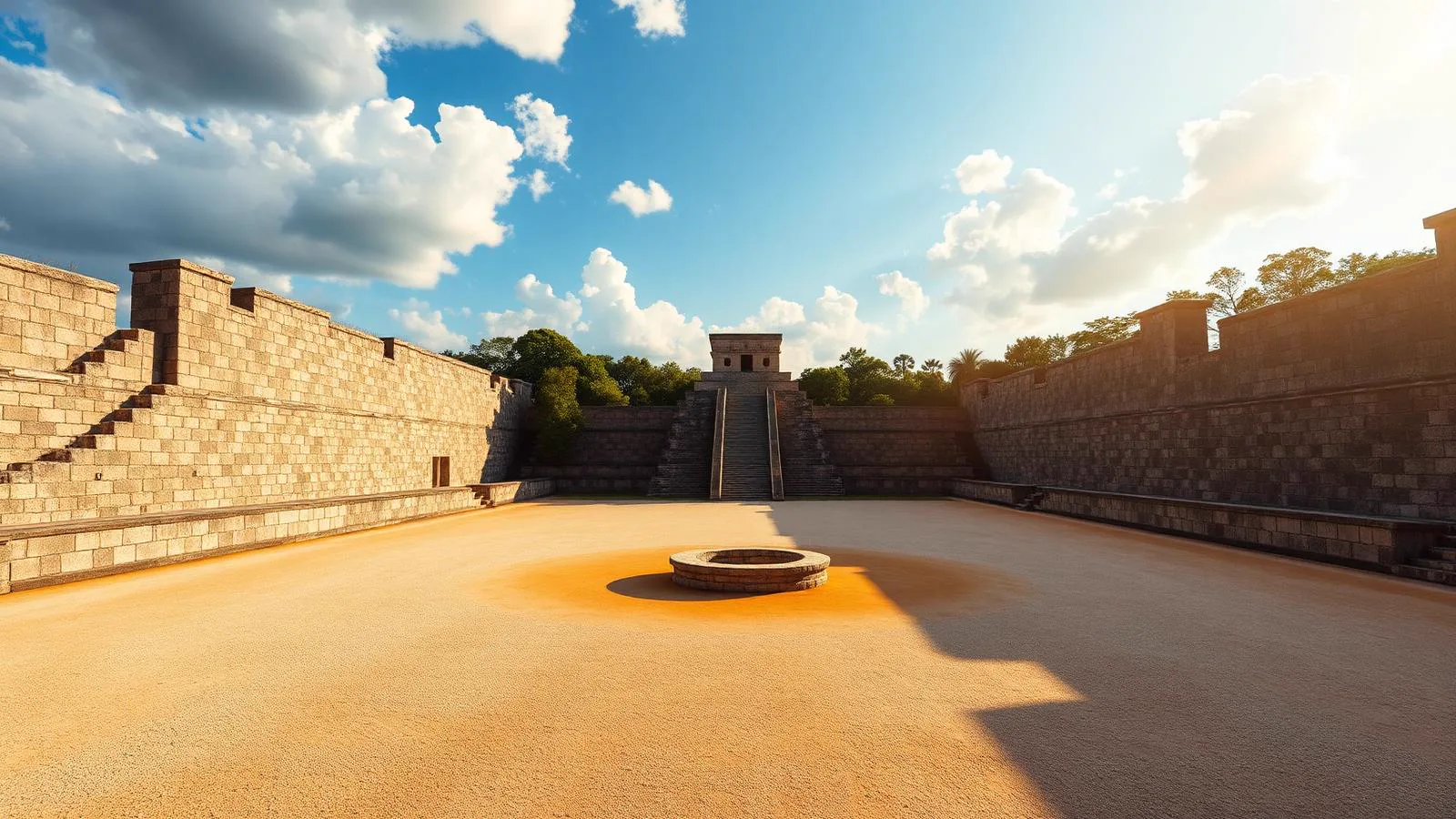
The Chichen Itza ball court is a 168-metre by 70-metre I-shaped stone arena at the north end of the Chichen Itza archaeological zone. Built around 864 AD and known as the Great Ball Court, it is the largest ballcourt so far found in Mesoamerica. Two parallel 8-metre walls, twin stone rings and six carved decapitation panels frame the alley where the Maya played the ritual game of pok-ta-pok.
This guide covers the court's definition and dimensions, exact location inside the site, why it holds the record as the largest Mayan ball court in Mesoamerica, how the acoustics actually work, when it was built, how pok-ta-pok was played, what the six panels show, the surrounding temples, and how to visit it in 2026. Dates and figures follow INAH, UNESCO and the Schele–Mathews scholarly consensus.
What Is the Great Ball Court at Chichen Itza?
The great ball court at Chichen Itza is a monumental Maya sports and ritual arena where teams played the Mesoamerican ballgame under state supervision. It is one of thirteen ball courts documented at the site by INAH, but the only one built at monumental scale, the rest are smaller neighbourhood courts distributed across the 5 km² zone. Its formal Maya name is unknown; the Spanish descriptor Juego de Pelota Grande dates from the 19th century.
The court functioned as three things at once: a sports arena where a rubber ball had to pass through a stone ring six metres above the floor, a religious stage where the game re-enacted the Popol Vuh myth of the Hero Twins defeating the lords of Xibalba, and a political theatre where rulers displayed captives and staged sacrifice as public spectacle. It belongs to the peak era of Chichen Itza's political history, roughly 800 to 1100 AD.
How Large Is the Ball Court? Dimensions, Layout, and I-Shape Design
The playing alley measures 168 metres long by 70 metres wide (551 feet by 230 feet), enclosed by parallel side walls 8 metres high (26 feet). Two smaller structures close each end of the alley: the North Temple and the South Temple, together giving the plan its distinctive I-shape. Including these end temples, the full complex covers roughly 12,000 square metres. The floor is packed limestone stucco; the walls are ashlar-cut limestone blocks.
Two carved stone rings project inward from the side walls, one on the east wall and one on the west, mounted six metres above the floor. Each ring is roughly one metre in diameter and features two entwined feathered serpents whose heads meet at the top. Getting a rubber ball through this vertical ring, with only hip and forearm contact allowed, was rare and match-ending. Most games ended on points scored by walls and floor marks rather than by ring shots.
| Element | Measurement | Note |
|---|---|---|
| Playing alley length | 168 m (551 ft) | North Temple to South Temple |
| Playing alley width | 70 m (230 ft) | Wall to wall |
| Side wall height | 8 m (26 ft) | Vertical inner face |
| Stone rings | ~1 m diameter | 6 m above floor, both walls |
| Full complex area | ~12,000 m² | Alley + North + South Temples |
| Bench panels | 6 total | 3 per wall, at base |
Where Is the Ball Court Located Inside the Archaeological Site?
The ball court at Chichen Itza sits in the Grupo del Norte (Northern Group), 150 metres north-west of El Castillo pyramid and 300 metres south of the Sacred Cenote. Walking from the west gate of the archaeological zone, the court is the second monument on the standard route, after El Castillo and before the Platform of the Skulls (Tzompantli). GPS coordinates: 20.6851° N, 88.5692° W.
The site's location within the wider archaeological zone matters for pacing: most visitors reach the court within 15 minutes of entering the west gate. Skirting the perimeter takes 20 minutes at a walking pace; a full acoustic-and-photo visit takes 30 to 40 minutes. If you want to place the court in relation to the whole city plan, the entry-level overview is in the Chichen Itza monuments overview.
Why Is This the Largest Mayan Ball Court in Mesoamerica?
The Chichen Itza arena is the largest Mayan ball court in Mesoamerica because no other pre-Columbian court, at any confirmed site, exceeds its 168-metre playing length. The next largest surviving courts, at Tikal, Copán, Uxmal, Monte Albán and Coba, are less than half its length. Comparative dimensions have been measured by INAH and cross-checked against on-site surveys by the Carnegie Institution and later Mexican missions.
| Court | Culture | Length | Region |
|---|---|---|---|
| Great Ball Court, Chichen Itza | Maya | 168 m | Yucatan, Mexico |
| Ballcourt, Tikal (Plaza) | Maya | ~30 m | Petén, Guatemala |
| Ballcourt A-III, Copán | Maya | ~26 m | Copán, Honduras |
| Ballcourt, Uxmal | Maya (Puuc) | ~34 m | Yucatan, Mexico |
| Ballcourt, Monte Albán | Zapotec | ~40 m | Oaxaca, Mexico |
| Macron Ballcourt, Coba | Maya | ~40 m | Quintana Roo, Mexico |
Scale carried political meaning. Building the largest court in the Maya world advertised Chichen Itza's regional dominance during its 10th-century peak and gave rival city-states a physical benchmark of Itza power. A court this size could also host thousands of spectators, meaning that political rituals staged there had audience reach unavailable to smaller sites.
How Do the Ball Court's Acoustics Actually Work?
The Chichen Itza ball court acoustics work through two overlapping effects. First, a hand clap at the North Temple produces up to nine distinct echoes as the sound wave bounces between the parallel 8-metre walls, with each reflection reaching a listener at the far end at a measurable time interval. Second, a normal-volume whisper delivered along the axis of the alley remains intelligible after travelling the full 168 metres. Both effects are reproducible; guides demonstrate them daily.
A 2006 acoustic study published in the Journal of the Acoustical Society of America measured the phenomenon and attributed it to three factors: the near-parallel geometry of the side walls, the reflective properties of dressed limestone, and the total absence of a roof, which prevents sound absorption above the alley. Wall imperfections mean the effect strengthens along certain axes and weakens along others.
In 1931 the American conductor Leopold Stokowski spent four days at the site attempting to reverse-engineer the acoustics for a planned open-air concert hall in the United States. Stokowski was unable to reproduce the effect and abandoned the project. Whether the Maya engineered the acoustics deliberately or discovered them incidentally through repeated construction remains an open scholarly question.
When Was the Court Built? The 864 AD Ring Inscription
The Great Ball Court was completed around 864 AD, a date recorded on a hieroglyphic inscription carved into one of the two surviving stone rings. The Maya Long Count date on the ring reads 10.1.15.3.6, converted to 20 January 864 AD in the Gregorian calendar under the widely used GMT-584283 correlation. This makes the court one of the few structures at Chichen Itza with a precise construction date recorded in stone by its builders.
Construction sat inside Chichen Itza's peak building era, roughly 800–1050 AD, when the city was expanding under strong Toltec-influenced style. The court remained in continuous ritual use until the city's political collapse around 1200 AD. After abandonment the alley silted up and the North Temple partially collapsed; both were cleared and stabilised in the 1920s and 1930s during Carnegie Institution restoration campaigns led by Sylvanus Morley.
How Was Pok-Ta-Pok Played on This Court?
Pok-ta-pok teams played on this court in short matches of two rounds each. Two teams of two to seven players faced off across the centre line and had to keep the 3–4 kg solid-rubber ball in play using only the hip, thigh, forearm and shoulder, hands, feet and head were forbidden. Points came from wall marks, floor faults by the other side, and, rarely, from passing the ball through one of the vertical stone rings, which ended the match instantly.
Playing gear included a padded leather hip yoke, forearm wraps and knee protectors, needed because the ball hit at close-combat force. The Chichen Itza variant of the game was more heavily ritualised than the everyday version played on smaller neighbourhood courts across Mesoamerica. Full rules, historical variants and the game's spread from Olmec origins are covered in the wider Mesoamerican ballgame literature.
What Do the Six Decapitation Panels Show, Winner or Loser Sacrificed?
Six bas-relief panels run along the base of the ball court walls, three on each side, carved into hard limestone in the mid-9th century. Each panel shows two teams of seven players flanking a central scene: one player kneels while another, in matching regalia, holds his severed head. Streams of blood from the neck transform into seven serpents in each carving, a visual metaphor for the earth's fertility rebirth after ritual death.
Which figure represents the winner and which the loser has been debated since Alfred Maudslay first documented the panels in 1889. The current academic consensus, developed by Linda Schele and Peter Mathews in The Code of Kings (1998), reads the kneeling figure as the losing captain and the standing figure holding the head as the winning captain: the standing figure wears the elaborate feathered headdress and hip yoke consistent with victory regalia across other Maya reliefs. The 20th-century tourist story that the winner was sacrificed as an honour is not supported by the iconography.
Sacrifice at Chichen Itza was more likely reserved for high-value captives, enemy nobles, war captives, or losing team captains representing subject cities. The Great Ball Court was one of several ritual stages for these events; the nearby Sacred Cenote received a second class of offerings, including individuals thrown alive into the water.
What Are the Temples Around the Great Ball Court?
Four temples frame the Great Ball Court complex, each dedicated to a different political or religious function. The Upper Temple of the Jaguars sits atop the east wall and faces inward over the alley, giving elite spectators a direct view of play. The Lower Temple of the Jaguars stands below it and opens outward toward the wider plaza. At the north end stands the North Temple, also called the Temple of the Bearded Man for the carved figure inside; at the south end, the smaller South Temple closes the I-shape.
The Upper Temple of the Jaguars is decorated with feathered-serpent columns, jaguar-relief benches and wall panels that depict warriors and rulers, Linda Schele read these as Itza founders rather than the Toltec migrants earlier archaeologists proposed. The North Temple contains the carved bearded figure and additional bench reliefs; both temples once held wooden lintels of sapodilla wood, some of which are preserved in the British Museum after Alfred Maudslay's 19th-century casts and removals.
The main pyramid of Chichen Itza sits 150 metres south-east of the ball court and shares the same visual axis as the North Temple. For its exact measurements and equinox-shadow mechanics, see the dedicated El Castillo pyramid.
How to Visit the Ball Court Today (2026 Rules, Photos, Timing)
Visiting the ball court in 2026 takes 30 to 40 minutes for a full circuit and works best in the first hour after gates open at 8:00 AM. INAH closes the playing alley itself to foot traffic, so you cannot walk on the stone floor; you can walk the entire outside perimeter, enter the Lower Temple of the Jaguars viewing platform, and stand directly under the west-wall stone ring. Photography is free with a handheld camera or phone; tripods and drones require separate INAH permits.
Timing and light
Morning light between 8:00 and 10:00 AM strikes the east wall at a low angle and rims the stone ring cleanly, the best window for photographing the ring against the sky. Midday light flattens the wall reliefs. Late-afternoon crowds from Cancun tour buses reach the site around 11:30 AM; after that the court fills with 200–400 visitors clustered near the acoustic demonstration point at the North Temple.
Guide clap demonstration
Every certified guide runs the same short demonstration: a single hard hand clap from the base of the North Temple, followed by silence so the group can count the echoes. Nine reflections is common; five to seven is normal on windy or humid days. Site rules ask visitors not to clap independently once a demonstration is underway. Practical logistics, hours, fee, entry queue, dress code, are covered in the Chichen Itza schedule and Chichen Itza admission guides.
Planning a Visit to the Ball Court
The Great Ball Court reads better when you know the numbers before you see it, the 168-metre length, the six panels, the 864 AD date on the ring, and the nine-echo acoustic effect that Stokowski could not reproduce. Standing in front of a wall built to stage rulership through ritual sport is different from staring at a stone rectangle. If you want a certified guide who will run the acoustic demo and read the panel iconography at pace, Itza Quest operates Chichen Itza tour formats from Cancun, Playa del Carmen, Tulum and Merida.
The court explains the architecture; the sport itself needs its own page. Scoring, the rubber ball weight, the hip-only rule, the Popol Vuh myth behind it and the sacrifice debate are covered in the Mayan ball game guide.
Continue reading
Related guides with the same travel intent.
Frequently Asked Questions
How big is the Chichen Itza ball court?
The Chichen Itza ball court measures 168 metres long by 70 metres wide, with parallel side walls 8 metres high. Including the North and South Temples that close each end, the full I-shaped complex covers about 12,000 square metres. It is the largest ball court so far found anywhere in the pre-Columbian Americas, larger than every other Maya, Aztec, Zapotec or Olmec court on record.
Was the winner or the loser sacrificed at the Great Ball Court?
The losing team captain was sacrificed at the Great Ball Court, according to the current academic consensus led by Mayanist Linda Schele. The six carved bas-relief panels running along the base of both walls show a kneeling player being decapitated while the standing figure holds his head, the standing figure carries the winner's regalia. The older tourist story that the winner was sacrificed as an honour is a 20th-century embellishment not supported by the iconography.
Why does the Chichen Itza ball court echo so much?
The court's parallel stone walls, 8 metres high and 70 metres apart, form a natural resonant chamber. A hand clap at one end produces up to nine distinct echoes as the sound reflects back and forth. A whisper travels the full 168-metre length end-to-end and remains audible. Leopold Stokowski studied the effect for four days in 1931 hoping to reuse it in an open-air concert hall; he was unable to reproduce the acoustics elsewhere. Modern physicists attribute the effect to wall geometry and limestone surface texture.
Can you enter the Great Ball Court at Chichen Itza today?
You cannot walk on the playing floor of the Great Ball Court. INAH closed the alley in 2006 and roped the perimeter to protect the stone panels from foot traffic. You can walk the full outside perimeter, stand under the stone ring on the west wall, and enter the Lower Temple of the Jaguars viewing platform. Most guides demonstrate the acoustics with a single hand clap from the North Temple entrance.
When was the Great Ball Court built?
The Great Ball Court was completed around 864 AD, a date recorded on a hieroglyphic inscription carved into one of the surviving stone rings. Construction fell within Chichen Itza's peak era (approximately 800–1050 AD), when El Castillo, the Temple of the Warriors and the Group of a Thousand Columns were also built. The court stayed in use for public ritual until the city's political decline around 1200 AD.
How heavy was the ball used at the Chichen Itza ball court?
The rubber ball used in the ball game weighed between 3 and 4 kilograms, roughly the weight of a small bowling ball. It was made of solid latex from the chicle tree (the same tree that later supplied commercial chewing gum), rolled into a dense sphere 25 to 30 centimetres across. Players struck the ball with the hip, thigh, forearm and shoulder only. Hands, feet and head were not allowed. Padded leather yokes protected the hip, which took most of the impact.