
Chichen Itza Facts: 30 Things You Should Know Before You Visit in 2026

30 verified Chichen Itza facts: El Castillo's 365 steps, the equinox serpent shadow, the Kukulkan chirp, the Sacred Cenote, New 7 Wonders, UNESCO and Maya history.
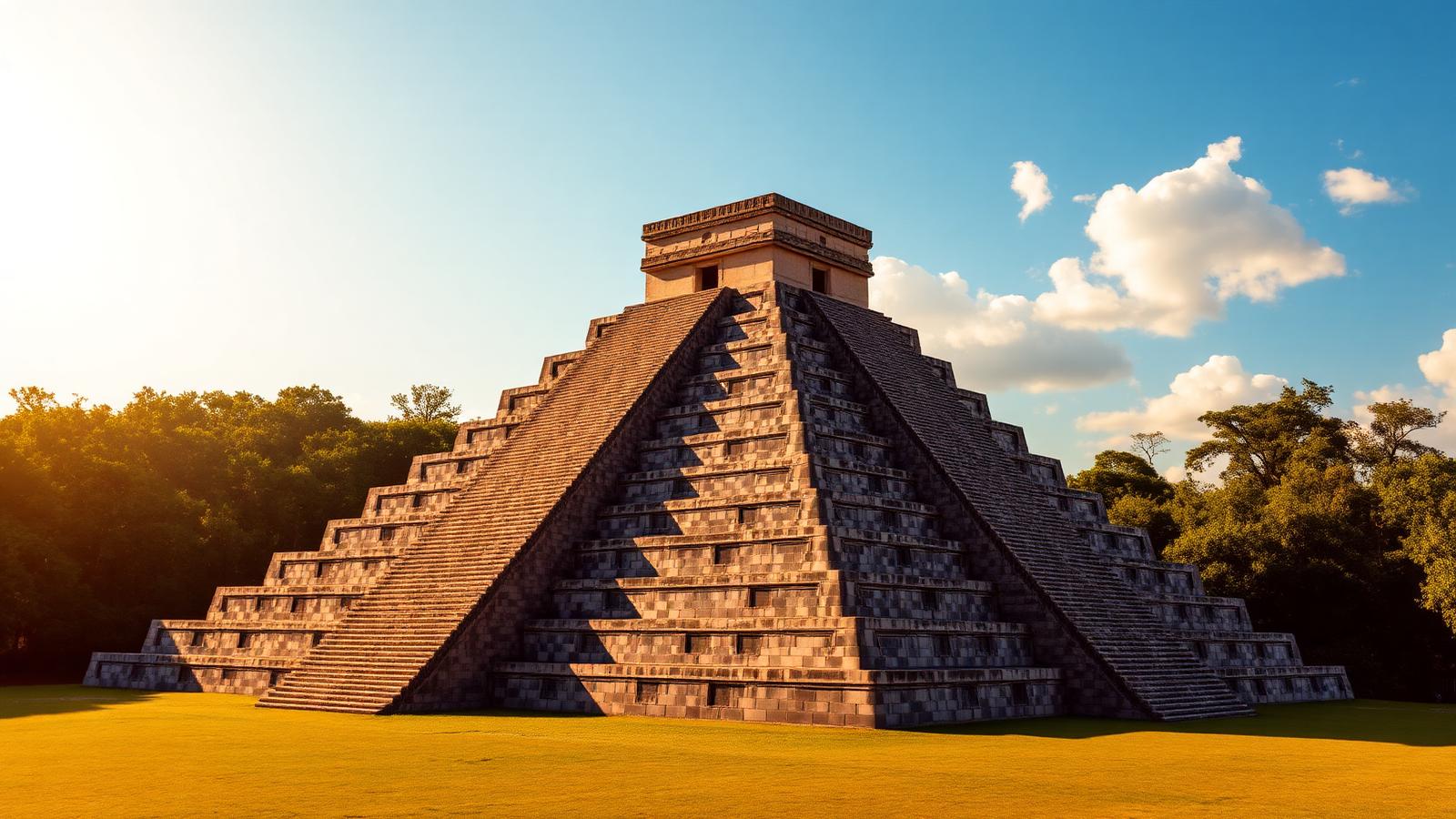
Chichen Itza facts stack up fast: a 30-meter pyramid with 365 steps that doubles as a solar calendar, a serpent-shaped shadow that appears twice a year, an echo shaped like a sacred bird's call, a sinkhole that swallowed offerings for six hundred years, and a New Seven Wonders vote that pulled 100 million ballots. This guide gives the 30 verified facts about Chichen Itza that actually matter for a 2026 visit, grouped by monument, by history, and by the modern honors that keep drawing 2.5 million people a year to a single site in the Yucatan jungle.
Every number below comes from INAH (Mexico's National Institute of Anthropology and History), UNESCO's 1988 inscription file, or peer-reviewed archaeology. Popular claims that fail those sources, the 'perfectly aligned', 'built by aliens' or 'exact center of Mesoamerica' kind, are flagged and corrected.
Quick Facts About Chichen Itza: The 15-Second Summary
These are the facts about Chichen Itza worth memorizing before you land in Yucatan. They cover location, size, age, ownership, status and scale of visitation, the questions every traveler asks in the first minute at the site.
| Fact | Detail |
|---|---|
| Location | Tinum, Yucatan, Mexico · 20.6829° N, 88.5686° W |
| Site area | ~10 km² (26 main structures) |
| Age | Occupied ~600–1200 AD; peak 800–1100 AD |
| Builders | Maya (Itza lineage) with later Toltec influence |
| Owner / manager | INAH (federal) with the state of Yucatan |
| UNESCO status | World Heritage Site since 1988 |
| Wonder status | New 7 Wonders of the World since July 7, 2007 |
| Visitors 2025 | ~2.5 million (Mexico's #1 archaeological site) |
| Ticket 2026 (foreigner) | See current INAH + CULTUR breakdown in the Chichen Itza entrance fee guide |
| Hours | See current schedule in the Chichen Itza opening hours guide |
For the full hour and season windows check the Chichen Itza opening hours guide; for the exact fee breakdown and what each part covers, the Chichen Itza tickets guide.
Where Is Chichen Itza and How Big Is the Site?
Chichen Itza sits in the north-central Yucatan Peninsula at 20.6829° N, 88.5686° W, in the municipality of Tinum, state of Yucatan, Mexico. It is 40 km west of Valladolid, 120 km east of Merida, 200 km west of Cancun International Airport and 175 km northwest of Tulum. The archaeological zone open to visitors measures 47 hectares (about 0.47 km²), roughly the size of 65 soccer fields; the wider urban footprint of the ancient city extended over about 10 km² and included around 26 documented monumental structures plus hundreds of smaller platforms and residential mounds mapped by INAH since the 1920s.
A common visitor misconception is that El Castillo is the only major building. It is the tallest and most photographed, but the site holds ten equally important structures, the Great Ballcourt (168 m long, the largest in Mesoamerica), the Temple of the Warriors, the Group of a Thousand Columns, the Observatory (El Caracol), the Nunnery, the Church, the Tzompantli platform of skulls, the Platform of the Eagles and Jaguars, the Sacred Cenote and the Ossuary. Walking all of them at a normal pace takes 2.5–3 hours. Any 'quick 45-minute' tour skips at least half the site.
Fun Facts About Chichen Itza Most Visitors Don't Know
These fun facts about Chichen Itza rarely appear in the standard brochure but come straight from INAH excavation reports and peer-reviewed astronomy papers. They are the sort of details that change how the site looks when you are standing in front of it, the reason a private guide is worth having beside you at the base of the pyramid.
| # | Fun fact | Source |
|---|---|---|
| 1 | El Castillo hides an older, smaller pyramid inside it, and inside that, a red-painted jaguar throne with jade eyes | INAH excavation, 1935 |
| 2 | The pyramid sits on top of a natural cenote 20 m below the surface, confirmed by 3D electrical-resistivity imaging | UNAM survey, 2015 |
| 3 | The Great Ballcourt's acoustics carry a whispered voice 135 m across without amplification | Journal of the Acoustical Society, 2004 |
| 4 | The Observatory (El Caracol) has windows aligned to the extreme positions of Venus | UT Austin, Aveni 1975 |
| 5 | The Tzompantli platform once displayed hundreds of real human skulls on wooden racks | Landa, Relación 1566 |
| 6 | Human sacrifice at Chichen Itza included children, not only warriors, per DNA analysis of Sacred Cenote remains | Nature 2024 |
| 7 | The 'chirp echo' matches the frequency of the quetzal bird within 3 % | Lubman, 1998 |
| 8 | The site had a paved white road (sacbé) system connecting it to Yaxuná 100 km away | INAH mapping, 1993 |
| 9 | The 365-step count works only if you count the top platform step, a design choice, not a coincidence | Aveni, Skywatchers 2001 |
| 10 | Chichen Itza is not perfectly north–south, it is rotated 22° east of true north, aligned to a bright star setting | Aveni & Hartung 1978 |
El Castillo / Kukulkán Pyramid Facts: The Numbers and the Two Tricks
El Castillo is 30 m tall, 55.3 m square at the base, built in nine platforms with 365 steps (91 per side plus one top step), rotated 22° east of true north, and hides an older, smaller pyramid inside it that archaeologists found in 1935. Climbing has been banned since 2006 after a fall killed a visitor. Twice a year at the equinoxes, the setting sun paints seven linked triangles of light down the north balustrade, ending at a stone serpent head, the descent of Kukulkán. Physicist David Lubman measured in 1998 that a clap 20 m from the staircase returns as a chirping echo within 3% of a recorded quetzal call, produced by the stepped geometry acting as a comb filter.
How the light forms a serpent on the stairs twice a year is explained in Chichen Itza snake shadow.
For the full dimensions, the inner pyramid with the red jaguar throne, the detailed acoustic explanation and why climbing is closed, see the dedicated Kukulkan Pyramid guide.
Chichen Itza History Facts: The Four Phases in One Paragraph
Founded around 600 AD around two natural cenotes, grown by the Itza lineage from 800 AD, peaked as the dominant northern-Maya capital between 900 and 1100 AD (when El Castillo, the Ballcourt and the Temple of the Warriors were built), collapsed in about a generation around 1200 AD, likely from internal political fracture rather than any single catastrophe.
For the full timeline, the known rulers and the exact role of the Toltec influence, see the Chichen Itza history guide.
Sacred Cenote Facts: The Number That Surprised Everyone
A 2024 Nature DNA study of remains recovered from the Sacred Cenote confirmed that most of the roughly 200 sacrificed individuals were male children from local Maya families, not war captives, and not the young women of popular myth. The cenote itself is 60 m wide with vertical walls dropping 27 m to a green pool 13 m deep, 300 m north of El Castillo along sacbé number one.
For the dedicated cenote guide with full history, dredge finds and why swimming is not allowed, see the Cenote Sagrado at Chichen Itza. For the swimmable cenote 3 km from the site, that is Cenote Ik Kil.
Interesting Facts About Chichen Itza's Modern Recognition
The interesting facts about Chichen Itza in the modern era are three big honors and one big number. First, UNESCO inscribed the site as a World Heritage Site on December 11, 1988, under criteria (i), (ii) and (iii), outstanding artistic value, important interchange of civilizations, and unique testimony to Maya culture. Second, on July 7, 2007 in Lisbon, Chichen Itza was voted one of the New Seven Wonders of the World in a global poll organized by the Swiss New7Wonders Foundation with over 100 million votes cast. Third, in 2010 the Mexican federal government bought the private ranch that contained the ceremonial core from the Barbachano family for 220 million pesos, making the entire main site public property for the first time in modern history. Fourth, the site now receives about 2.5 million visitors per year, more than any other archaeological zone in Mexico and roughly double the pre-pandemic figure for Teotihuacán.
The busiest single date at the site is the spring equinox around March 20, when 20,000–30,000 people gather to watch the serpent shadow. If your priority is avoiding crowds instead of catching the equinox, see when to visit Chichen Itza.
How to See These Facts With Your Own Eyes in 2026
Every fact in this guide is checkable on the ground in a single day. To hear the quetzal chirp, stand 20 m in front of the north staircase of El Castillo and clap once, sharp and loud. To see the smaller inner pyramid, look for the sealed doorway on the north face at ground level; you cannot enter, but a guide will point out the boundary line. To feel the ballcourt acoustics, stand at either end of the Great Ballcourt while your travel partner whispers from the opposite end, the whisper carries the full 135 m. To see the Sacred Cenote up close, walk the 300 m sacbé causeway north from the plaza; the wooden viewing platform overlooks the water. To catch the serpent shadow, arrive at the site by 3:30 PM on March 20 or September 22 and stand at the northwest corner of El Castillo, the effect starts around 4:00 PM and peaks near 5:00 PM.
A self-guided visit gives you the visual facts but not the layers of context, the exact excavation date, the archaeologist's name, the citation for the science paper. A luxury Chichen Itza tour with a private historian adds that context on the ground with a dedicated specialist, not a shared group guide. If you are leaving from the westernmost island on the coast, ferry logistics and timing are on the Chichen Itza tour from Cozumel page. If you want the fully private version, dedicated vehicle, your own departure time, private guide, that is the format of the private Chichen Itza tour we run at Itza Quest.
Two facts on this page open into their own guides. The pyramid contains an earlier pyramid with a red jaguar throne, sealed to visitors since 2006, described in what is inside the Chichen Itza pyramid. And the 168-metre arena hosted a sport with rules most visitors get wrong, covered in the Mayan ball game guide.
Continue reading
Related guides with the same travel intent.
Frequently Asked Questions
What are 5 facts about Chichen Itza?
(1) Chichen Itza is a UNESCO World Heritage Site (inscribed 1988) and one of the New Seven Wonders of the World (voted 2007). (2) The El Castillo pyramid stands 30 m tall and has 365 steps combined, one for each day of the solar year. (3) Twice a year, on the March and September equinoxes, the setting sun casts a serpent-shaped shadow down the north staircase. (4) A single clap in front of the north staircase returns an echo that mimics the call of the quetzal bird. (5) The site draws about 2.5 million visitors a year, more than any other archaeological site in Mexico.
What is Chichen Itza?
Chichen Itza is a pre-Columbian Maya archaeological site in the municipality of Tinum, state of Yucatan, Mexico. It was a Maya city-state that reached its peak between 800 and 1100 AD. The site covers about 10 km² and holds 26 main visitable structures, including El Castillo, the Temple of the Warriors, the largest Mesoamerican ballcourt and the Sacred Cenote. It is a UNESCO World Heritage Site and one of the New Seven Wonders of the World.
How old is Chichen Itza?
The settlement is about 1,500 years old. Occupation began around 600 AD, political peak ran 800–1100 AD, and the site was abandoned as a capital by about 1200 AD. The visible El Castillo pyramid was built between 800 and 1000 AD, on top of an earlier smaller pyramid dated to roughly 550 AD.
Who built Chichen Itza?
Chichen Itza was built by the Maya, specifically the Itza, a Maya group whose name means 'sorcerers of the water'. The name 'Chichen Itza' is Yucatec Maya: chi ('mouth'), chen ('well'), itzá ('of the Itza'), 'at the mouth of the well of the Itza'. Toltec architectural influence from central Mexico appears in later phases (900–1200 AD), but the city was built and ruled by the Maya.
How many steps does the Chichen Itza pyramid have?
El Castillo has 91 steps on each of its four sides, plus the top step of the temple platform, for a total of 365, one for each day of the 365-day Maya haab solar year. This number is deliberate: El Castillo functions as a three-dimensional calendar. Climbing has been banned since 2006 to protect the stonework.
Why is Chichen Itza a wonder of the world?
Chichen Itza was voted one of the New Seven Wonders of the World on July 7, 2007 in Lisbon, after a global poll organized by the Swiss New7Wonders Foundation drew over 100 million votes. It won on architectural and engineering value (solar calendar, acoustics, astronomical alignment), state of preservation, and its role as the standout of Maya civilization. It shares the list with Machu Picchu, Petra, Christ the Redeemer, the Colosseum, the Taj Mahal and the Great Wall of China.
What is the serpent shadow at Chichen Itza?
Twice a year, at the spring equinox (~March 20) and the autumn equinox (~September 22), the late-afternoon sun casts a series of triangular shadows on the north staircase of El Castillo that form the undulating body of a serpent descending the pyramid. The shadow lines up with the carved stone serpent head at the base, representing Kukulkan the feathered serpent coming down to earth. The effect lasts about 45 minutes and is a deliberate demonstration of Maya astronomical precision.
Does Chichen Itza really have a special echo?
Yes. A single clap in front of the north staircase of El Castillo returns a chirping, descending echo that sounds like the call of the quetzal, the sacred Maya bird. Physicist David Lubman documented the effect in 1998 by measuring the acoustic response, the staircase steps act as a filter that lowers frequency progressively. In the Great Ballcourt, a spoken word at one end can be heard clearly 135 m away at the other end without any amplification.