
Chichen Itza Photography Guide: 12 Shots, Camera Rules and Light Angles

Chichen Itza photography guide 2026: exact INAH camera rules, drone and tripod policy, lens kit for El Castillo, hour-by-hour light angles, 12-shot list for the plaza, phone vs mirrorless settings, equinox serpent-shadow logistics, and post-processing tips from a local Yucatan photographer.
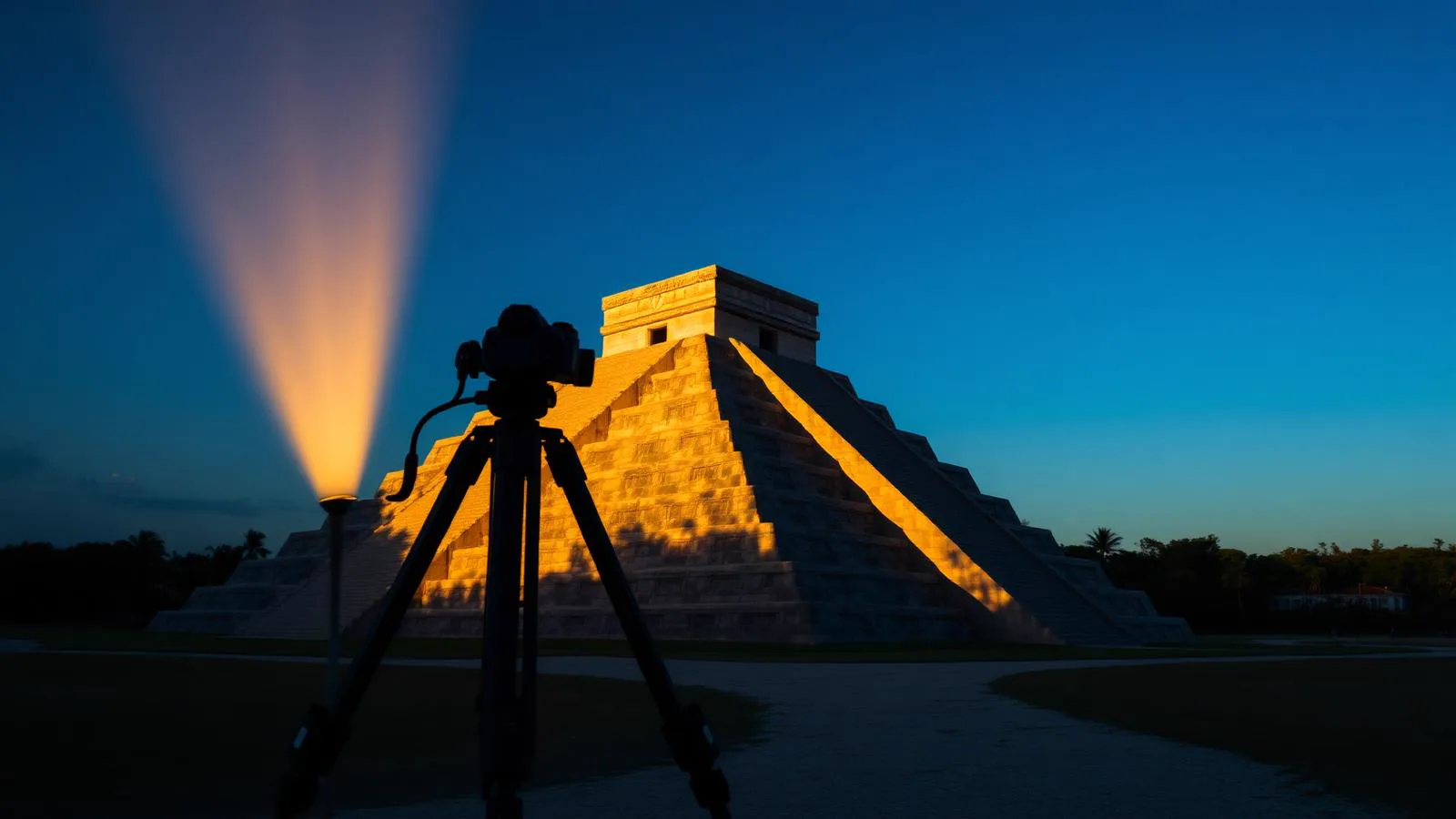
Chichen Itza photography works around three fixed rules: cameras enter free, tripods cost 45 pesos, drones are banned. The plaza rewards a 24–70 mm zoom, an 8:00 a.m. or 4:00 p.m. arrival, and a shot list of twelve structures. This guide covers gear, INAH camera rules, light angles and post-processing from a local Yucatan photographer.
Chichen Itza is the most-photographed archaeological site in Mexico and the second most-photographed UNESCO monument in the Americas after Machu Picchu. Roughly 8,000 visitors pass through the plaza on a high-season day and every one arrives with a camera, so the difference between a snapshot and a portfolio-grade image is not gear, it is timing, angle and permit paperwork.
The plaza sits on flat limestone at 41 metres above sea level and receives more than 300 sunny days per year. That combination means highlights blow easily, shadows are short, and the same camera settings work from November through April with minor tweaks. The two variables you actually manage are the arrival hour and the direction you point the camera.
What Are the INAH Camera Rules at Chichen Itza in 2026?
INAH camera rules at Chichen Itza break into four tiers in 2026. Personal cameras of any kind enter free. Tripods, monopods and gimbals need a 45-peso sticker permit bought at the ticket booth. Drones are banned nationwide in every INAH zone. Commercial shoots require a paid federal permit filed weeks ahead, expect roughly 5,900 pesos per shoot day and a written scope.
| Equipment | Permit needed | Fee (2026) | Notes |
|---|---|---|---|
| DSLR / mirrorless / bridge camera | None | Free | Any lens size, any brand |
| Smartphone | None | Free | RAW / ProRAW allowed |
| GoPro / action cam (hand-held) | None | Free | Handheld only, no drone mount |
| Tripod / monopod / gimbal | Sticker permit | 45 pesos | Bought at ticket booth, dated |
| Dedicated video camera / rig | Video permit | 45 pesos | Same permit as tripod |
| Drone / UAV of any size | Prohibited | , | Fines from 20,000 pesos |
| External flash / softbox / reflector | Commercial permit | ~5,900 pesos/day | Advance filing |
| Commercial or client shoot | Federal INAH permit | ~5,900 pesos/day | Contact INAH Mexico City |
The tripod sticker is enforced by uniformed guards at every structure. They ask to see the sticker before you extend legs, and they will politely fold the tripod if you skipped the booth. Buy the permit even if you only think you might set up, 45 pesos is roughly USD 2.50 and saves the walk back.
Gear Kit: Lens Choice for the Chichen Itza Plaza
A single 24–70 mm f/2.8 zoom covers the majority of the plaza work, architecture at 24 mm, El Castillo full-frame at 35–50 mm, mid-detail at 70 mm. Add a 70–200 mm for the compressed pyramid shot from behind the Warriors Temple, the giant serpent-head sculpture at the base of the north stairway, and the Sacred Cenote seen across the sacbé. A wide 16–35 mm is optional, the only place it earns its slot is the interior of the Great Ball Court, where the 168-metre corridor exceeds a 24 mm.
| Focal length | Best use at Chichen Itza | Priority |
|---|---|---|
| 16–35 mm | Great Ball Court interior, temple bases from close range | Optional |
| 24–70 mm | El Castillo full-frame, plaza wides, mid-range detail | Essential |
| 70–200 mm | Serpent-head sculpture, compression on El Castillo, Sacred Cenote | Highly recommended |
| 100 mm macro | Carved reliefs, hieroglyphs on the Nunnery and Osario | Niche |
| Polariser filter | Deep-sky pyramid shots, glare cut on limestone | Essential |
| 3-stop ND filter | Long-exposure clearing of tourists at 30–60 seconds | Optional |
| Travel tripod (carbon) | Long exposures, low ball-court light, self-portraits | Bring the 45-peso permit |
| Spare battery + 64 GB card | Heat drains batteries fast on the open plaza | Essential |
When Is the Best Light for Photographing El Castillo?
El Castillo faces the four cardinal directions, which means every face gets direct sun at a predictable window. The north face, the famous serpent stairway, takes side-light from roughly 3:30 to 5:00 p.m. year-round and is the money shot for equinox coverage. The west face glows warm from 4:00 p.m. onward. The south face receives morning wraparound from 8:00 to 10:00 a.m. The east face is the sunrise face and is not accessible to visitors before opening.
| Hour on site | Best face to shoot | Light quality |
|---|---|---|
| 08:00 – 09:00 | South and south-west | Long shadows, cool amber, empty plaza |
| 09:00 – 10:30 | West face wide | Soft directional, low tourists |
| 10:30 – 12:00 | Detail work in shade | Skip pyramid faces, harsh |
| 12:00 – 14:00 | Ball Court interior + carved reliefs | Overhead, worst for stone |
| 14:00 – 15:30 | East and north-east | Recovering light, tourists peak |
| 15:30 – 16:45 | North face (serpent stairway) | Rake side-light, best of the day |
| 16:45 – 17:00 | West face + Sacred Cenote path | Warm golden hour, clearing crowds |
The plaza opens at 8:00 a.m. year-round with last entry at 4:00 p.m., the schedule detail lives in our Chichen Itza opening hours if you need it before booking flights.
The 12-Shot Shot List for Chichen Itza
A tight shot list keeps a three-hour visit productive and stops the plaza from swallowing the schedule. The twelve shots below cover the site's identity structures, the images anyone looking at your gallery expects to see, plus three secondary landmarks that most travellers walk past. Work them in listed order and you finish before the 10:30 a.m. crowd wave arrives from Cancun.
| # | Shot | Best focal | Best hour |
|---|---|---|---|
| 1 | El Castillo west face, plaza wide | 24–35 mm | 8:15 a.m. or 4:15 p.m. |
| 2 | El Castillo north stairway with serpent heads | 50–85 mm | 3:30–4:45 p.m. |
| 3 | Compressed El Castillo from behind Warriors Temple | 100–200 mm | 8:30 a.m. |
| 4 | Great Ball Court corridor from north end | 16–24 mm | 9:00 a.m. (backlit) or 3:00 p.m. |
| 5 | Warriors Temple + Chac Mool + Thousand Columns | 24–35 mm | 8:45 a.m. |
| 6 | Thousand Columns receding into distance | 50–70 mm | 9:15 a.m. |
| 7 | Tzompantli skull-rack platform detail | 70–100 mm | 9:30 a.m. |
| 8 | Sacred Cenote across the sacbé | 35–70 mm | 10:00 a.m. |
| 9 | El Caracol observatory dome | 24–50 mm | 10:30 a.m. |
| 10 | Nunnery (Casa de las Monjas) façade carvings | 50–100 mm | 3:00 p.m. |
| 11 | High Priest's Grave (Osario) detail | 35–70 mm | 3:15 p.m. |
| 12 | El Castillo silhouette against sunset sky | 35–70 mm | 4:45 p.m. |
The Sacred Cenote sits 300 metres north of El Castillo along the ceremonial sacbé and rewards a compressed 70 mm shot rather than a wide, its ritual significance and history are covered in our Sacred Cenote Chichen Itza.
Which Camera Settings Work Best in the Chichen Itza Sun?
Base settings for the plaza are aperture priority at f/8, ISO 100 fixed, and matrix or evaluative metering biased –0.7 EV to protect the sunlit limestone highlights. The RAW file recovers 2–3 stops of shadow but zero of blown-out white stone, so under-expose the pyramid a touch and lift in post. A polarising filter rotated to darken the sky cuts glare off the west and north faces by about 1.5 stops and deepens the blue by two shades.
| Scenario | Aperture | ISO | Shutter (typical) | Note |
|---|---|---|---|---|
| Bright plaza midday | f/8 | 100 | 1/500 s | –0.7 EV to save highlights |
| Golden hour side-light | f/5.6–f/8 | 100 | 1/250 s | Polariser on |
| Ball Court interior shade | f/4 | 400 | 1/125 s | Tripod useful |
| Serpent-head close-up | f/5.6 | 200 | 1/250 s | 70–200 mm at 135 mm |
| Equinox serpent-shadow | f/8 | 100–200 | 1/250 s | Tripod + polariser off |
| Silhouette against sunset | f/8 | 100 | Meter the sky | Expose for sky, subject goes dark |
| Handheld long ND (clear crowds) | f/11 | 100 | 30–60 s + ND | Tripod + 45-peso permit |
Equinox Photography: The Kukulcan Serpent-Shadow Logistics
The Kukulcan serpent-shadow at Chichen Itza is a light-and-shadow illusion produced by the pyramid's stepped north-west corner casting seven triangular shapes down the north stairway as the sun sets on March 20–21 and September 22–23. The effect starts around 3:30 p.m., peaks between 4:15 and 4:45 p.m., and dissolves near 5:00 p.m. Position yourself on the plaza grass west-north-west of El Castillo with the north stairway centred in frame.
Expect 8,000–15,000 visitors on the equinox afternoon. Arrive at opening (8:00 a.m.), shoot the plaza work in the morning cool, then reserve your grass position by 2:00 p.m., the front rows fill first and INAH staff redirect late arrivals behind rope lines. A 24–105 mm lens covers the pyramid full-frame with breathing room for the shadow to complete. The pyramid is also photographable from a smaller crowd on the west face during the same window.
Phone vs Mirrorless: Where Each Wins at Chichen Itza
A modern flagship phone shot in ProRAW or RAW covers the plaza-scale wides (shots 1, 4, 5, 8) at a level that survives Instagram and small prints. Phones lose two categories: compressed telephoto (shots 2, 3, 11 need real 100 mm+ glass) and clean shadows in the Ball Court interior. Mirrorless wins on dynamic range for silhouettes at sunset and on the equinox where the pyramid highlights blow out on a phone. Bring the phone regardless, it is the fastest way to capture the twelve-shot list before crowds arrive.
Managing Crowds in Frame Without a Drone
Crowd management is the single hardest problem at Chichen Itza because drones are banned and the plaza fills fast after 10:30 a.m. Three techniques work. First, arrive at 8:00 a.m. and shoot the pyramid faces before Cancun vans arrive. Second, use a tripod and a 3-stop ND filter for a 30–60 second exposure, moving tourists blur out and vanish while the stone stays sharp. Third, shoot tight on architecture with a 70–200 mm and let compression eliminate the ground where people stand.
Peak crowd density hits between 11:00 a.m. and 1:30 p.m. as tour vans converge, the hourly breakdown lives in our how crowded Chichen Itza gets if you want to plan around it.
Post-Processing: Colour Grading Yucatan Limestone
Yucatan limestone photographs cold and slightly cyan straight out of camera because the sky bounces onto every sunlit face. Warm the white balance to 5,700–6,100 K in RAW, lift shadows by +30 to reveal terrace detail, drop highlights by –25 to protect the stone, and add +15 clarity for micro-contrast in the carvings. Green the trees around the plaza with a small vibrance push (+10) rather than global saturation, which would push the stone yellow.
For the equinox serpent-shadow, keep the highlight slider closer to –10 (the shadow itself must stay dark against the sunlit stairway) and boost the dehaze slider by +15 to sharpen the seven triangular shapes. Convert the sky to a linear blue mask and drop luminance by –15 to intensify the contrast against the pyramid without touching the stone.
Photography-Friendly Day Plan From Each Departure City
A photography-first day plan requires an 8:00 a.m. arrival at the gate, which pins your departure time from each Riviera Maya city. From Cancun leave by 5:30 a.m., from Playa del Carmen by 5:45 a.m., from Tulum by 6:00 a.m., from Merida by 6:30 a.m., and from Valladolid by 7:15 a.m. A private driver (rather than a group shuttle) is the only realistic way to hit these departure times because the standard tours leave hotels at 7:00–8:00 a.m. and reach the site at 10:30 a.m., far past the golden window.
The full driving math, toll roads, fuel budgets and door-to-door hours, is in the distance guides for Cancun, Playa del Carmen and Tulum.
Final Take: Timing Beats Gear at Chichen Itza
Chichen Itza photography is decided at the gate, not in the camera bag, the visitors who leave with portfolio images are the ones inside the plaza at 8:00 a.m. with a tripod permit already stuck to the leg, working the twelve-shot list before the 10:30 a.m. crowd wave lands. Itza Quest builds sunrise-arrival private tours with a photographer-aware driver, tripod-permit purchase handled on your behalf, and a certified Mayan guide who knows exactly where to stand for every shot in this guide.
Continue reading
Related guides with the same travel intent.
Frequently Asked Questions
Can you bring a professional camera into Chichen Itza?
Yes. Personal DSLR and mirrorless cameras enter free. A commercial-use permit is only required if you shoot for advertising, film production or paid client work, INAH charges roughly 5,900 pesos per day for that permit. Amateur and travel photography carries no extra fee and no lens restriction.
Are tripods allowed at Chichen Itza?
Tripods are allowed for a 45-peso permit purchased at the ticket booth. Monopods and gimbals also fall under this permit. Guards enforce the sticker rule strictly, set up a tripod without it and you will be asked to fold it. The permit sticker is single-use and dated for the day of your visit.
Are drones allowed at Chichen Itza?
No. INAH prohibits all drone flights inside every federal archaeological zone in Mexico, including Chichen Itza. The ban is nationwide and applies from the parking area onward. Fines start at 20,000 pesos plus drone confiscation. Aerial footage of the plaza that appears on YouTube dates from before 2018 or comes from paid film-permit shoots.
What is the best time of day to photograph El Castillo?
The two golden windows are 8:00–9:30 a.m. and 4:00–4:45 p.m. Morning light rakes across the north face and separates the nine terraces; afternoon light sculpts the west face and the serpent-shadow stairway. Midday flattens the stone and produces harsh sensor-clipping highlights on the limestone.
What lens should I bring to Chichen Itza?
A 24–70 mm zoom covers 90 % of the plaza work, architecture, pyramid full-frame and mid-range detail. Add a 70–200 mm for the serpent-head sculpture, the Sacred Cenote across the sacbé, and compression shots of El Castillo from the Warriors Temple. A wide 16–35 mm handles the interior of the Great Ball Court.
Can you photograph the equinox serpent-shadow at Chichen Itza?
Yes, twice a year. The Kukulcan serpent-shadow forms on the north stairway of El Castillo between roughly 3:30 and 5:30 p.m. on March 20–21 and September 22–23. Position yourself west-north-west of the pyramid on the plaza grass; a 24–105 mm covers the pyramid full-frame with breathing room. Expect 8,000+ visitors that afternoon.
What camera settings work best in the Chichen Itza midday sun?
Aperture priority at f/8, ISO 100, shutter falls where it needs. Meter for the sunlit limestone to protect highlights and lift shadows in post, the sensor recovers 2–3 stops of underexposure but 0 of blown white stone. A polarising filter deepens the sky and cuts glare off the pyramid faces by roughly 1.5 stops.
Can I photograph Chichen Itza well with just a phone?
Yes, if you shoot in RAW/ProRAW and stay off digital zoom. Modern phones nail the plaza-scale wide shot and the mid-range stone-detail shot. Where phones lose is the compressed telephoto, the serpent-head sculpture from the plaza and the pyramid from behind the Warriors Temple both need a real 100 mm+ lens. Bring a small tripod for the low-light Ball Court interior.
Where is the best spot for the classic El Castillo photo?
Walk 30 metres onto the plaza grass west of El Castillo and drop your camera to knee height. This angle isolates the pyramid on clean sky, uses the low limestone to lead the eye, and keeps stray tourists out of frame. A 35–50 mm lens covers the pyramid with symmetric side terraces and a small margin of foreground stone.
How many photos should I plan to take at Chichen Itza?
Bring at least 32 GB of card space. A focused 3-hour visit yields 300–500 raw frames if you shoot 4–8 exposures per landmark across the twelve main structures. Serious equinox coverage or a full sunrise-to-late-afternoon session can push past 1,200 frames, carry a spare battery because heat drains cells fast in the open plaza.
Can you photograph inside the Great Ball Court and other structures?
Yes. Photography is free inside every accessible plaza area, including the Great Ball Court corridor, the Warriors Temple base and the Tzompantli platform. Interior chambers of the pyramids are permanently closed to the public, so the only interior shots you can make are the standing corridor of the ball court and the columns of the Thousand Columns group.
Is video allowed at Chichen Itza?
Personal video from a hand-held camera or phone is allowed with no permit. A dedicated video camera or a rig with an external light or shoulder support requires a 45-peso video permit at the ticket booth, the same permit that covers tripods. Anything that looks like a professional shoot triggers a request for the commercial-use INAH permit at the gate.