
Chichen Itza vs Coba: The 2026 Comparison From a Yucatan Local

Chichen Itza vs Coba 2026: honest side-by-side comparison. Real INAH fees, Nohoch Mul climbing status, jungle setting vs restored plaza, bicycle sacbé rides, best departure city, cenote pairings, and a 12-hour itinerary that combines both sites when you have one day in the Yucatan.
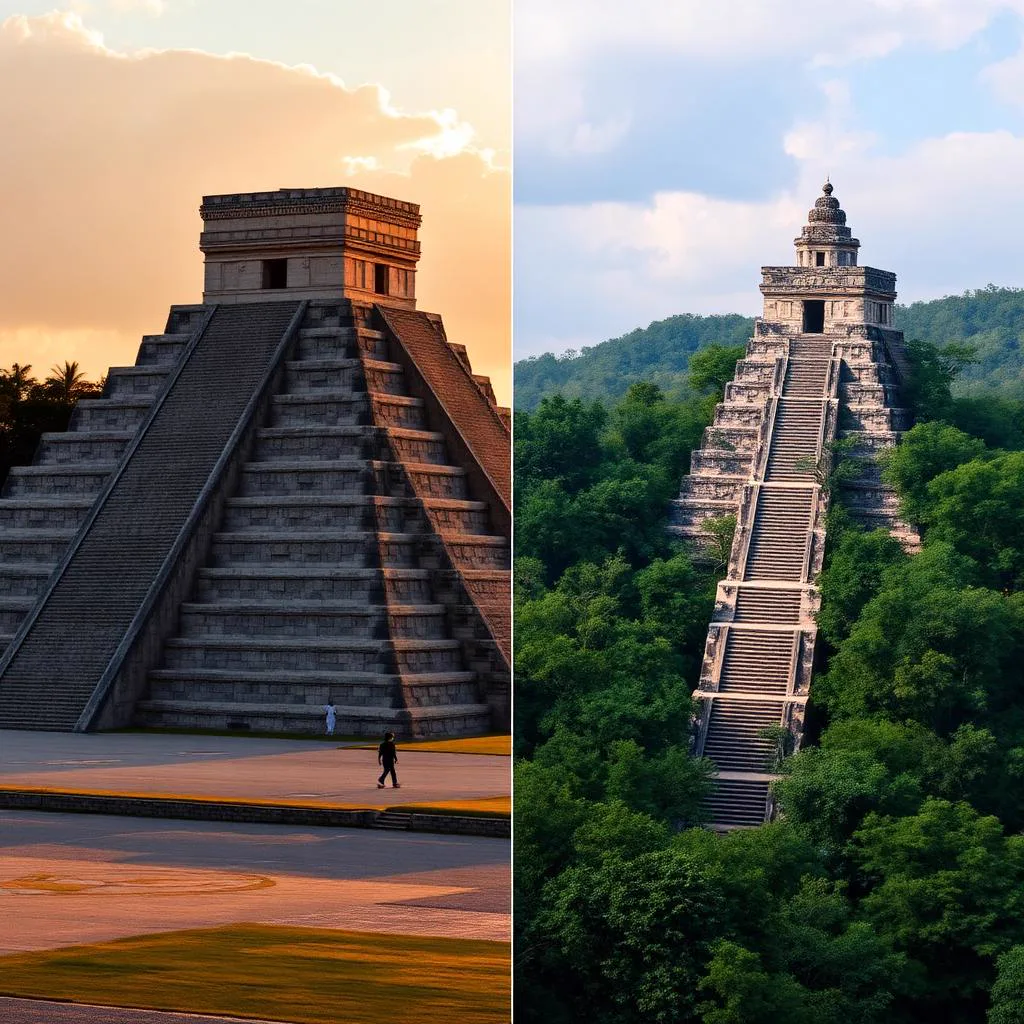
Chichen Itza wins on scale, UNESCO status and Maya-Toltec architecture; Coba wins on jungle atmosphere, sacbé bicycle rides and quiet crowds. Chichen Itza costs 720 pesos and a 12-hour day; Coba costs about 120 pesos and 4–5 hours from Tulum. If you visit only one Yucatan Mayan site, choose Chichen Itza.
Chichen Itza vs Coba is the second-most-asked archaeological question in Yucatan travel, right after the Tulum comparison.
Both sites are Mayan archaeological zones administered by INAH on the Yucatan Peninsula, and both appear on Tulum and Playa del Carmen day-tour brochures. The similarities end there, Chichen Itza is a restored monumental capital; Coba is a jungle-shrouded network city connected by raised stone causeways called sacbeob.
Chichen Itza peaked between 600 and 1200 AD, was inscribed on the UNESCO World Heritage list in 1988, and stands as one of the New Seven Wonders of the World. Coba peaked earlier, between 500 and 900 AD, spans an 80 km² network with the 42-metre Nohoch Mul pyramid, the tallest surviving Mayan pyramid in the Yucatan Peninsula, but remains largely un-restored and un-cleared under jungle canopy.
Chichen Itza vs Coba: The 90-Second Verdict
First-time Yucatan visitors with one Mayan slot should choose Chichen Itza, the UNESCO capital delivers the Kukulcan pyramid, the Great Ball Court and the Sacred Cenote in a single restored plaza. Travelers already sleeping in Tulum who want a half-day of atmosphere plus a bicycle ride through the rainforest should choose Coba.
With five or more days on the peninsula you should visit both. The two sites sit only 100 km apart along Highway 109 and answer completely different traveler questions, restored architecture vs living jungle, rather than duplicating each other.
At-a-Glance Comparison: Chichen Itza vs Coba in 2026
The at-a-glance comparison shows Chichen Itza wins on entrance-fee value, restoration, UNESCO status and guide-led education; Coba wins on tallest surviving pyramid, jungle setting, bicycle access and low crowd density. The two sites are complementary, different Mayan periods, different landscapes, different atmospheres.
| Factor | Chichen Itza | Coba |
|---|---|---|
| Site classification | UNESCO World Heritage · New 7 Wonders | INAH archaeological zone (not UNESCO) |
| Mayan period | Terminal Classic (600–1200 AD) | Classic (500–900 AD) |
| Mapped area | ~4 km² restored core | ~80 km² network / 5 km² walkable |
| Tallest structure | Kukulcan pyramid (24 m, no climbing) | Nohoch Mul pyramid (42 m, no climbing since 2020) |
| 2026 foreign adult entry | 720 pesos (~USD 39) | ~120 pesos (~USD 6.50) |
| Time on site | 2.5–3 hours (3.5 h with guide) | 2–2.5 hours (with bicycle) |
| Setting | Open restored plaza, dry jungle | Dense rainforest canopy |
| Site transport | Walking only | Bicycle 55 pesos / tricycle taxi 150 pesos |
| Distance from Tulum | 155 km / 2h 20 min | 47 km / 45 min |
| Distance from Cancun airport | 200 km / 2h 40 min | 170 km / 2h 10 min |
| Best paired cenote | Cenote Ik Kil (5 km) | Multum Ha / Choo Ha (8 km) |
| Daily visitors (high season) | ~8,000 | ~1,500 |
| Guide value | Essential | Optional |
| Mosquitoes / jungle discomfort | Low | Moderate, bring repellent |
Historical Depth: A Restored Capital vs a Jungle Network City
Chichen Itza is a monumental Terminal Classic capital dominated by Maya-Toltec fusion architecture; Coba is an older Classic-period network city whose 50+ raised sacbé causeways once tied smaller settlements to a central plaza. Chichen Itza reads as a single ceremonial stage; Coba reads as an entire distributed metropolis you cycle across.
The Kukulcan pyramid at Chichen Itza encodes the 365-day solar calendar in its stairs and hosts the equinox serpent-shadow. The Great Ball Court beside it is the largest in Mesoamerica at 168 metres long. The Sacred Cenote north of the plaza served as a ritual sacrifice site, and its dredged offerings now sit in the Peabody Museum and Merida's INAH collection.
Coba centres on Nohoch Mul, 'the great mound' in Yucatec Maya, a 42-metre pyramid that remains the tallest surviving Mayan pyramid in the Yucatan Peninsula. Around it sit the Coba group with its own ball court, the Macanxoc group with a stela field, and the Pinturas group with painted murals. The five interior lakes gave Coba reliable water and made it a Classic-period trade hub.
Coba is not UNESCO listed and never appeared on the New Seven Wonders vote. If the deep Mayan story is what you came for, our Chichen Itza history walks the full 700-year arc and connects the two sites in context.
Nohoch Mul Climbing: Closed Since 2020, Not Reopening
INAH closed the Nohoch Mul pyramid to public climbing in March 2020 for combined safety and preservation reasons, and the ban remains in force in 2026. Older travel articles that promise a Coba climb, the last big ruin you could still ascend, are simply out of date. You can walk to the base of Nohoch Mul and photograph the 120-step stairway from below, but the rope line is enforced.
Chichen Itza closed climbing on Kukulcan much earlier, in 2006, after a fatal fall. Neither site allows any climbing today. If ascending a Mayan pyramid is a bucket-list item, the only nearby option left is Ek Balam near Valladolid, where the Acropolis remains climbable in 2026.
Cost Reality: 2026 Entrance Fees and Total Day Budgets
Chichen Itza foreign adult entry costs 720 pesos in 2026, 100 pesos INAH federal plus 620 pesos Yucatan state CULTUR fee. Coba costs roughly 100 pesos INAH plus a modest Quintana Roo state surcharge, around 120 pesos total. Chichen Itza is about 6x more expensive at the gate; the surplus funds Yucatan's Noches de Kukulcan light show and the site's paved infrastructure.
At Coba you should budget extra for site transport: bicycle rental is 55 pesos, or a tricycle taxi with a local driver is 150 pesos each way to Nohoch Mul. Neither option exists at Chichen Itza, where the plaza is compact enough to walk. Both sites charge 45–65 pesos for video-camera permits and prohibit drones.
The complete price breakdown, including guide and transport add-ons for the flagship site, lives in our Chichen Itza entrance fee.
| Cost item (2026, per adult) | Chichen Itza | Coba |
|---|---|---|
| INAH federal fee | 100 pesos | 100 pesos |
| State fee (Yucatan / Quintana Roo) | 620 pesos | ~20 pesos |
| Total foreign adult entry | 720 pesos (~USD 39) | ~120 pesos (~USD 6.50) |
| Parking | 80 pesos car | 60 pesos car |
| Bicycle rental on site | n/a | 55 pesos |
| Tricycle taxi to Nohoch Mul | n/a | 150 pesos each way |
| Certified INAH guide | USD 60–90 group | USD 30–45 group |
| Round-trip transport from Tulum | USD 60–110 shared / 220+ private | USD 25–45 shared / 100+ private |
| Sample full day tour | USD 60–140 with cenote + lunch | USD 55–95 with cenote |
Crowd Reality: Why Coba Feels Empty at Noon
Both sites open 8:00 a.m. with very low density and both peak between 10:30 a.m. and 1:00 p.m. as Tulum and Playa del Carmen tour vans arrive. The difference is absolute volume: Chichen Itza receives roughly 8,000 visitors on a typical high-season day; Coba receives around 1,500. Coba's jungle canopy and long sacbé causeways also disperse people fast, so even at the peak window Coba feels empty compared to the packed Chichen Itza plaza.
For hour-by-hour density and the best arrival window at the flagship site, see our how crowded Chichen Itza gets.
Getting There: Which Departure City Wins for Each Site
Coba is best reached from Tulum (45 minutes on Highway 109); Chichen Itza is best reached from Valladolid (40 minutes on Highway 180D). From Cancun, Coba is 2h 10 min and Chichen Itza is 2h 40 min, both feasible day trips, though Chichen Itza justifies the earlier start. From Playa del Carmen, Coba is 90 minutes and Chichen Itza is 2h 30 min.
For door-to-door times, toll-vs-libre road choice and fuel budgets, see our distance guides, how far Chichen Itza is from Cancun, from Tulum, and from Playa del Carmen.
Cenote Pairing: Ik Kil for Chichen Itza, Multum Ha for Coba
Pair Chichen Itza with Cenote Ik Kil (5 km south of the archaeological zone). Pair Coba with Multum Ha, Choo Ha or Tamcach Ha, three cavern cenotes clustered 8 km south of the Coba gate, all covered by one combination ticket. Almost every private Chichen Itza day tour bundles Ik Kil at no extra cost; Coba day tours typically add a cenote for USD 20–30.
Ik Kil is the deep circular open-well cenote that appears in every Chichen Itza promotional photo, vines cascading 26 metres to the water. Multum Ha is a closed cavern cenote with a domed roof and single skylight; the water sits at a constant 25 °C year-round. Read the full Cenote Ik Kil before you commit to a day plan.
One-Day Combined Itinerary: Chichen Itza + Coba + Cenote
The two-in-one day is popular from Tulum and Valladolid because the 100 km between the sites is straight highway. Start early, tackle the bigger site first while you are fresh, hit the cenote at midday for a swim reset, then wind down at the smaller jungle site in the afternoon light.
| Time | Stop | Duration |
|---|---|---|
| 06:30 | Depart Tulum or Valladolid | , |
| 08:00 | Enter Chichen Itza at opening | 2.5 h |
| 10:45 | Drive to Cenote Ik Kil | 15 min |
| 11:00 | Swim + light lunch at Ik Kil | 1.5 h |
| 12:45 | Drive to Coba via Highway 109 | 1h 30 min |
| 14:15 | Enter Coba, rent bicycle | 2 h |
| 16:15 | Depart Coba for Tulum | 45 min |
| 17:00 | Arrive back in Tulum | , |
Who Should Choose Chichen Itza and Who Should Choose Coba
First-time Mexico visitors with one Mayan slot should choose Chichen Itza, its UNESCO and New Seven Wonders labels make it the single most bucket-list-satisfying archaeological visit in the country. Repeat visitors, jungle enthusiasts and travelers already in Tulum who want a slower half-day of atmosphere should choose Coba.
Families with kids 8 and older often prefer Coba, the bicycle ride and jungle wildlife hold attention better than a walking tour of a plaza. Photographers who value scale and side-light architecture should stay with Chichen Itza; photographers hunting jungle-atmosphere temples should pick Coba. Cruise passengers from Cozumel can realistically fit Coba into a shore day but not Chichen Itza.
Final Verdict: Chichen Itza First, Coba Second
If your Yucatan trip fits only one Mayan ruin, book Chichen Itza, the UNESCO capital delivers the Kukulcan pyramid and Sacred Cenote no other Mexican site can match. If your itinerary allows a second archaeological day, add Coba for its jungle sacbeob, Nohoch Mul pyramid and rare quiet on the trails. Itza Quest builds both routes into a single private day tour with a certified Mayan-descent guide, air-conditioned SUV and a cenote stop at no extra cost.
Continue reading
Related guides with the same travel intent.
Frequently Asked Questions
Which is better to visit, Chichen Itza or Coba?
Chichen Itza is better for architectural grandeur, UNESCO status and Maya-Toltec history; Coba is better for jungle atmosphere, sacbé bicycle rides and quiet crowds. If you can only see one Yucatan Mayan site, choose Chichen Itza, it delivers the Kukulcan pyramid and New Seven Wonders label Coba cannot match.
Can you still climb the Nohoch Mul pyramid at Coba in 2026?
No. INAH closed Nohoch Mul to climbing in 2020 and the ban remains in force in 2026 for both safety and preservation. You can walk to its base and photograph the 42-metre pyramid from below, but the 120-step ascent is roped off. Older travel articles that promise a Coba climb are out of date.
How much does it cost to enter Chichen Itza vs Coba in 2026?
Chichen Itza foreign adult entry is 720 pesos in 2026, 100 pesos INAH plus 620 pesos Yucatan state CULTUR fee. Coba is roughly 100 pesos INAH plus a small Quintana Roo state fee, around 120 pesos total. Chichen Itza costs about 6x more at the gate; Coba is one of the cheapest major Yucatan ruins.
How much time do you need at Chichen Itza vs Coba?
Plan 2.5–3 hours on site at Chichen Itza (3.5 with a guide) to cover the plaza, Kukulcan pyramid, Great Ball Court and Sacred Cenote. Plan 2–2.5 hours at Coba, the site is spread over 80 km² but only 5 km² is walkable; most visitors rent a bicycle or tricycle taxi to reach Nohoch Mul in 15 minutes.
Can you visit Chichen Itza and Coba in one day?
Yes. The two sites sit only 100 km apart along Highway 109. A workable 12-hour plan leaves Tulum or Valladolid at 6:30 a.m., enters Chichen Itza at 8:00 a.m., stops at Cenote Ik Kil, and reaches Coba by 1:30 p.m. before the 4:00 p.m. last entry. Cancun day-trips make this loop tight but doable with a private driver.
Is Coba worth visiting if you have already seen Chichen Itza?
Yes, for a completely different experience. Coba delivers jungle-shrouded temples, 50+ raised sacbé causeways and a bicycle-through-the-forest atmosphere you cannot get at the manicured Chichen Itza plaza. Skip Coba only if you have very limited time and want the single most iconic Mayan photograph; take it if you value atmosphere over restoration.
Which is closer to Tulum: Chichen Itza or Coba?
Coba is much closer to Tulum. From Tulum town it is 47 km / 45 minutes to Coba along Highway 109, versus 155 km / 2h 20 min to Chichen Itza on the same road plus Highway 180D. If you sleep in Tulum and want half a day of ruins, Coba is the natural pick; Chichen Itza is a full-day commitment.
Which cenote should I pair with Chichen Itza vs Coba?
Pair Chichen Itza with Cenote Ik Kil, the deep open-well cenote 5 km south of the ruins. Pair Coba with Cenote Multum Ha, Choo Ha or Tamcach Ha, three cavern cenotes clustered 8 km south of the Coba archaeological zone, all reachable in a single ticket. Almost every private tour bundles a cenote at no extra cost.
What are the opening hours of Chichen Itza vs Coba?
Chichen Itza opens 8:00 a.m. to 5:00 p.m., last entry 4:00 p.m., seven days a week. Coba opens 8:00 a.m. to 5:00 p.m., last entry 4:00 p.m., seven days a week. Both sites reward an 8:00 a.m. arrival, Chichen Itza to beat the Cancun buses, Coba to walk the jungle paths before midday heat and mosquitoes appear.
How crowded is Coba compared to Chichen Itza?
Coba is far quieter. Chichen Itza receives roughly 8,000 daily visitors in high season; Coba receives around 1,500. The jungle setting also disperses people fast along the sacbé trails, so even at midday Coba feels empty compared to the packed Chichen Itza plaza. This is the biggest atmospheric advantage of Coba.
Do you need a guide at Chichen Itza vs Coba?
A certified INAH guide is close to essential at Chichen Itza, the astronomical alignments and Maya-Toltec iconography read as blank stone without context. At Coba a guide adds far less; the site is less symbol-dense and most travelers happily explore by bicycle. A shared Chichen Itza guide costs USD 60–90; a Coba guide costs USD 30–45.
What is the best month to visit Chichen Itza or Coba?
November through early March is the best window for both, 24–30 °C, low humidity, no hurricane risk. Chichen Itza peaks around the March 20–21 and September 22–23 equinox for the Kukulcan serpent-shadow. Coba is best in dry season because jungle mosquitoes and mud on the sacbé peak from June through October. Avoid mid-July to late August at both.