
Sacred Cenote at Chichen Itza: The Sacrificial Well of the Maya Rain God

The Sacred Cenote at Chichen Itza is the sacrificial well of the ancient Maya, 60 m wide, 40 m deep, dedicated to Chaac the rain god. Full guide: what was thrown in, the 4,000 recovered offerings, the 200 skeletons, why you cannot swim there, and how to see it on site.
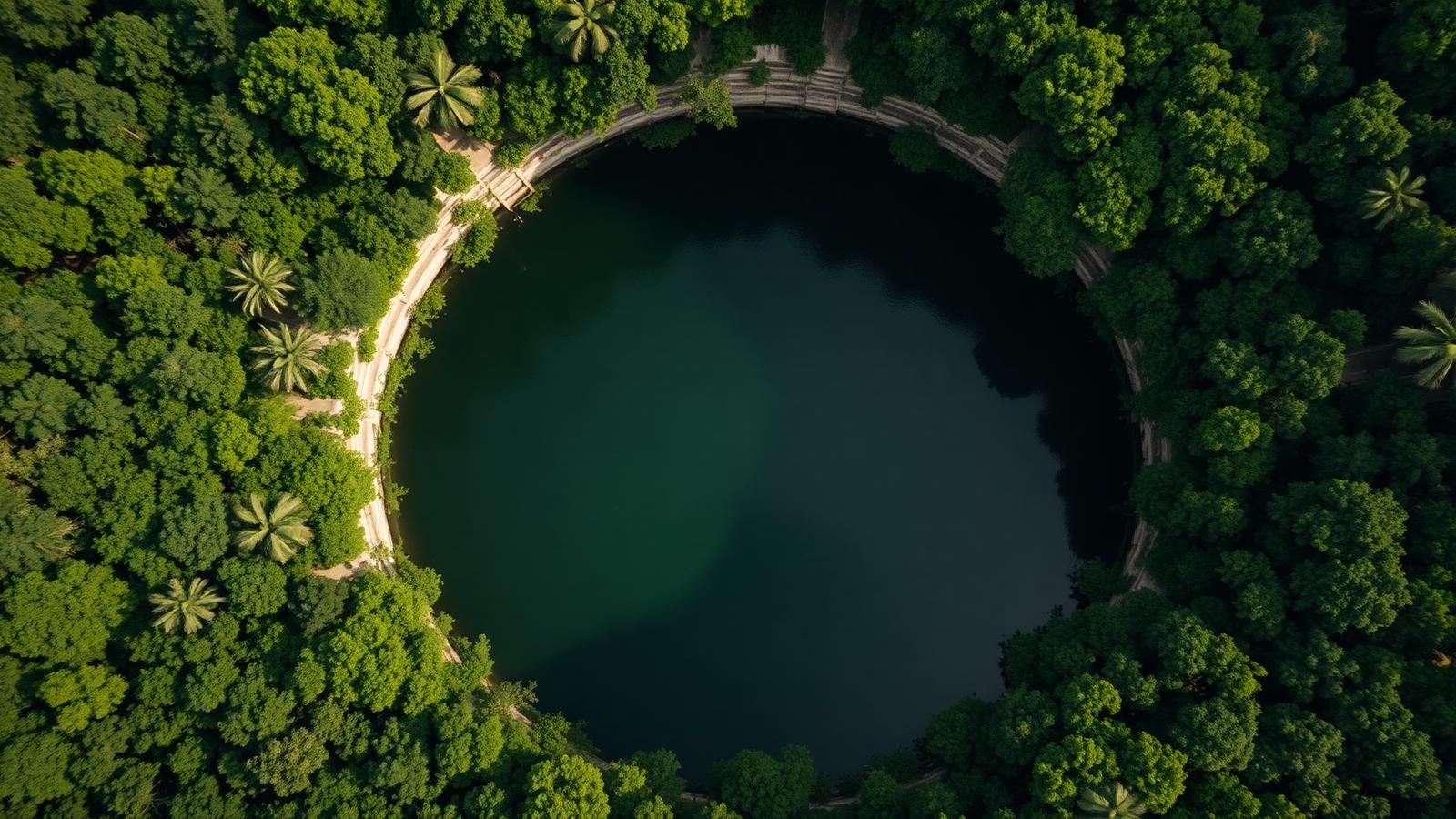
The Sacred Cenote at Chichen Itza is a natural sinkhole 60 meters across, 40 meters deep, sitting 300 meters north of El Castillo pyramid inside the archaeological zone. The ancient Maya used it exclusively as a sacrificial well dedicated to Chaac, the rain god. Between 1904 and 1968, archaeologists recovered over 4,000 offerings and roughly 200 human skeletons from its muddy bottom. Swimming is forbidden, a viewing platform above the north rim is the only public access. This is not Cenote Ik Kil, which is a separate swimming cenote 3 km east.
This guide covers the archaeology, the religious function, the exact objects recovered, the human remains debate, the Thompson dredging story, why swimming is prohibited, how to find the cenote inside the site, and how the Sacred Cenote differs from every other cenote in the Chichen Itza area. Data sourced from Peabody Museum catalogues, INAH records and published Mesoamerican archaeology through 2026.
What Is the Sacred Cenote: Location, Size and Formation
The Sacred Cenote is a natural karst sinkhole formed when a limestone cave roof collapsed thousands of years ago, exposing the underground aquifer that runs beneath the entire Yucatan Peninsula. Geologically it is identical to every other open cenote in the region, including Ik Kil, Xkeken and Samulá. What sets it apart is its cultural function: the ancient Maya chose it as the primary religious offering site of Chichen Itza, not as a water source.
| Feature | Measurement |
|---|---|
| Location | Inside Chichen Itza archaeological zone |
| Distance from El Castillo | 300 m north via Sacbé 1 |
| Coordinates | 20.6853° N, 88.5686° W |
| Diameter | 60 m (197 ft) |
| Rim height above water | 27 m (89 ft) |
| Water depth | 13 m (43 ft) |
| Mud/deposit depth | 3–4 m (10–13 ft) |
| Water visibility | Near zero (green, tannin-stained) |
| Public access | Viewing platform only, no descent |
The cenote is connected to the city's Great Plaza by Sacbé 1, a 6-meter-wide, 300-meter-long raised limestone ceremonial causeway built specifically to carry processions from El Castillo to the well. The sacbé is still visible today and is the trail every visitor walks. For full context on El Castillo, see the Pyramid of Kukulcán guide.
Religious Function: Why the Maya Made Sacred Cenote Offerings to Chaac
For the ancient Maya, cenotes were entrances to Xibalbá, the underworld, and specifically to the domain of Chaac, the rain god who commanded storms, lightning and agricultural fertility. The Sacred Cenote at Chichen Itza functioned as the most important Chaac contact point in the northern Yucatan. During years of good rainfall, offerings were modest, copal incense, jade beads, ceramic figurines. During prolonged droughts, the practice intensified, and objects of maximum value went in: gold discs beaten from Panamanian and Costa Rican metal, jade masks, and, in the most severe events, human beings.
This practice tracks the multi-decade droughts that pushed Chichen Itza out of political power around 1150 AD, the same environmental collapse documented in lake-sediment cores from Punta Laguna. For the full political timeline and the fall of the city, see the history of Chichen Itza.
What Was Thrown Into the Sacred Cenote: 4,000 Objects and 200 Skeletons
The total inventory recovered from the Sacred Cenote across all excavations (1904–1968) exceeds 4,000 objects plus roughly 200 sets of human remains. Materials came from an enormous geographic range, jade from Guatemala, gold from Panama and Costa Rica, obsidian from central Mexico, turquoise from northern Mexico or the American Southwest. This confirms Chichen Itza's role as the center of a continent-spanning trade network at its peak between 900 and 1100 AD.
| Category | Approx count | Origin / notes |
|---|---|---|
| Jade objects (beads, plaques, figurines) | 800+ | Motagua Valley, Guatemala |
| Gold discs, bells, sheets | 200+ | Panama, Costa Rica, hammered on site |
| Copper bells | 500+ | Central Mexico (Michoacán) |
| Ceramic vessels and figurines | 1,200+ | Yucatan, Petén, Veracruz |
| Obsidian blades and points | 600+ | Central Mexico (Pachuca) |
| Wooden objects (weapons, effigies) | 150+ | Preserved in anaerobic mud |
| Rubber effigies | 50+ | Southern Veracruz |
| Textiles (fragments) | Dozens | Rare survival, cotton and agave |
| Human remains | ~200 individuals | Mixed adults and children |
The human remains debate is more nuanced than popular versions suggest. Osteological reanalysis published in the 2000s and 2010s shows that many of the roughly 200 individuals were children between 3 and 11 years old, but not all deaths were sacrificial. Some skeletons show cutmarks and blunt trauma consistent with ritual killing; others were probably drowned or thrown post-mortem; a minority may have been drought-era famine deaths committed to Chaac secondarily. What is not disputed: children were specifically favored offerings in Maya rain rituals during severe drought.
Thompson Dredging: How the Sacred Cenote Was Excavated
Edward Herbert Thompson, U.S. consul in Merida and amateur archaeologist, is the figure who put the Sacred Cenote on the world archaeological map. Thompson bought the hacienda containing Chichen Itza in 1894 for 75 USD and spent the next decade preparing for a systematic recovery. Between 1904 and 1911 he ran a mechanical dredge over the cenote from a wooden platform on the rim, and later, trained by hardhat divers from Boston, descended in a diving suit to work the bottom manually.
Thompson shipped almost all recovered material to Harvard's Peabody Museum, where it was catalogued but hidden from Mexican archaeological review for decades. Mexico protested the removal and a long diplomatic negotiation followed. INAH ran additional Sacred Cenote expeditions in 1961 (Norman Scott and the Club de Exploraciones y Deportes Acuáticos) and in 1967–1968 (using airlift dredges), both of which recovered additional material and confirmed Thompson had missed thousands of smaller objects. Repatriation of Peabody artifacts to Mexico has continued in phases through 2024.
Why You Cannot Swim in the Sacred Cenote
Swimming, wading, diving and any physical descent into the Sacred Cenote are absolutely forbidden. INAH classifies the water and the bottom mud as protected archaeological deposits, every centimeter of sediment potentially contains offerings not yet recovered. Even the 1961 and 1968 dive expeditions required special federal permits and worked under archaeological supervision. Modern tourism access is limited to a viewing platform on the north rim above the water.
The common confusion: visitors read about a cenote at Chichen Itza and expect to swim. The swimming cenote, the one with the hanging vines and dive platforms that shows up in tour photos, is Ik Kil cenote, 3 km east of the ruins, outside the archaeological zone and with a separate entry ticket. If swimming is a priority, Ik Kil or the Valladolid cenotes are the right stops, a Chichen Itza, cenote and Valladolid tour combines the archaeological site with a real swimming cenote the same day.
How to Find the Sacred Cenote Inside Chichen Itza
From the main entrance of Chichen Itza, walk straight to El Castillo pyramid (about 5 minutes on the central path). From El Castillo, turn to the north side and follow the wide raised limestone causeway, Sacbé 1, for about 300 meters through low jungle. The path ends at the Sacred Cenote's viewing platform. Total walking time from entrance: 12–15 minutes. Most tour groups skip the Sacred Cenote because it sits at the far end of the site and adds 20 minutes to the visit.
A private guide who knows the site's chronology always includes Sacbé 1 and the Sacred Cenote in the walk, the cenote is contextually essential to understanding why Chichen Itza exists in the first place. Without it, the pyramid is just stone. With it, it is a working sanctuary. A private Chichen Itza tour ensures the Sacred Cenote is walked with the full explanation of Chaac, droughts and offerings. Drive times from the coast are detailed in the Chichen Itza tour from Playa del Carmen guide, the ideal halfway starting point between Cancun and Tulum.
Sacred Cenote vs Ik Kil vs Other Cenotes: What's Different
This is the single most common source of confusion in Chichen Itza visitor planning. The Sacred Cenote and Cenote Ik Kil are two entirely different sites with opposite functions. Below is the direct comparison, memorize which is which before you buy tickets.
| Feature | Sacred Cenote | Cenote Ik Kil |
|---|---|---|
| Location | Inside Chichen Itza site | 3 km east of ruins |
| Purpose | Sacrificial / religious | Modern swimming attraction |
| Swimming | Forbidden | Allowed with life jacket |
| Access | Included in INAH ticket | Separate 180 MXN ticket |
| Water color | Green, tannin-stained | Turquoise, clear |
| Facilities | Viewing platform only | Changing rooms, showers, restaurant |
| Depth to water | 27 m rim to surface | 26 m rim to surface |
| Water depth | 13 m + mud deposits | 40 m clear |
| Historical role | Chaac offering site | Not archaeologically significant |
Access ticketing and hours for the Sacred Cenote are covered by the official Chichen Itza ticket price. Follow the site's Chichen Itza schedule, the Sacred Cenote closes with the site at 5:00 PM and has no separate entry. The verified offering counts, 4,000 objects and 200 skeletons recovered, are among the best-documented Chichen Itza facts.
The Sacred Cenote is the reason Chichen Itza exists where it does. Every stone of El Castillo, every carving in the Great Ball Court, every warrior column in the Temple of the Warriors was built by a people whose survival depended on this one hole in the limestone answering their prayers for rain. Itza Quest walks the Sacbé and stops at the viewing platform on every guided visit so travelers leave understanding the city as a working religious system, not a photo backdrop.
Continue reading
Related guides with the same travel intent.
Frequently Asked Questions
What is the Sacred Cenote at Chichen Itza?
The Sacred Cenote (Cenote Sagrado, also called the Well of Sacrifice or Cenote of Sacrifice) is a natural circular sinkhole 300 meters north of El Castillo pyramid, inside the Chichen Itza archaeological zone. It measures 60 meters across, 27 meters from rim to water surface, and 40 meters deep. The Maya used it exclusively for religious offerings to Chaac, the rain god, never for drinking water or bathing.
Can you swim in the Sacred Cenote?
No. Swimming, wading, and any descent into the water are strictly forbidden at the Sacred Cenote. INAH classifies it as an archaeological artifact, the muddy bottom still holds unexcavated offerings and human remains. A viewing platform above the north edge is the only public access point. If you want to swim in a cenote near Chichen Itza, Cenote Ik Kil 3 km east is the standard swimming stop.
What was thrown into the Sacred Cenote?
Excavations recovered over 4,000 offering objects, including jade beads and figurines, gold discs and bells, copper bells from central Mexico and Panama, obsidian blades, ceramic incense burners, wooden weapons, textiles, rubber effigies, and copal incense. Human bones from roughly 200 individuals were also recovered, mostly children and young adults, dropped during severe drought years to petition Chaac for rain.
How deep is the Sacred Cenote?
The Sacred Cenote has 13 meters of water depth, with an additional 3–4 meters of dense mud and offering deposits at the bottom, for a total shaft of about 40 meters from surface plus the 27-meter drop from the rim. Visibility is near zero, the water is stained green by decomposed vegetation, tannins and mineral suspension. Divers must use lights and mud probes to work.
Who dredged the Sacred Cenote?
Edward Herbert Thompson, a U.S. consul and amateur archaeologist, dredged the Sacred Cenote between 1904 and 1911 after buying the surrounding hacienda for 75 USD in 1894. He shipped most of the recovered artifacts to Harvard's Peabody Museum, where they were catalogued. Later expeditions by Mexico's INAH in 1961 and 1967–1968 used dive teams and airlifts to recover more material. Many objects have been repatriated to the Museo Nacional de Antropología in Mexico City.
Were people really sacrificed at the Sacred Cenote?
Yes, but not on the mass scale that popular media suggests. Osteological analysis of the roughly 200 skeletons recovered shows a mix of ages, including many children, and cause of death is often ambiguous (drowning versus post-mortem deposit). Some skeletons show wounds consistent with sacrifice; others may have been symbolic reinternments. The practice was tied to drought, Chaac, the rain god, was believed to reside beneath the cenote, and offerings intensified during multi-year droughts documented between 800 and 1150 AD.
Where is the Sacred Cenote located inside Chichen Itza?
The Sacred Cenote sits 300 meters north of El Castillo pyramid, connected to the main plaza by a raised limestone causeway called sacbé number one, a 6-meter-wide ceremonial road built specifically to link the pyramid to the well. Walking the sacbé from El Castillo to the cenote takes 5–7 minutes. Coordinates 20.6853° N, 88.5686° W.
Is the Sacred Cenote the same as Cenote Ik Kil?
No, these are two completely different cenotes, and this is the most common confusion in Chichen Itza visitor planning. The Sacred Cenote is inside the archaeological zone, sacrificial, no swimming, viewing only. Cenote Ik Kil is 3 kilometers east of the ruins, a modern swimming attraction with dive platforms and life jackets. Both were geologically formed the same way, but their function and access are opposite.