
Temple of the Warriors at Chichen Itza: A Complete 2026 Guide

Inside the Temple of the Warriors at Chichen Itza, the Chac Mool statue, the Group of a Thousand Columns, 2026 climbing rules, real dimensions, and the Maya-Toltec debate explained.
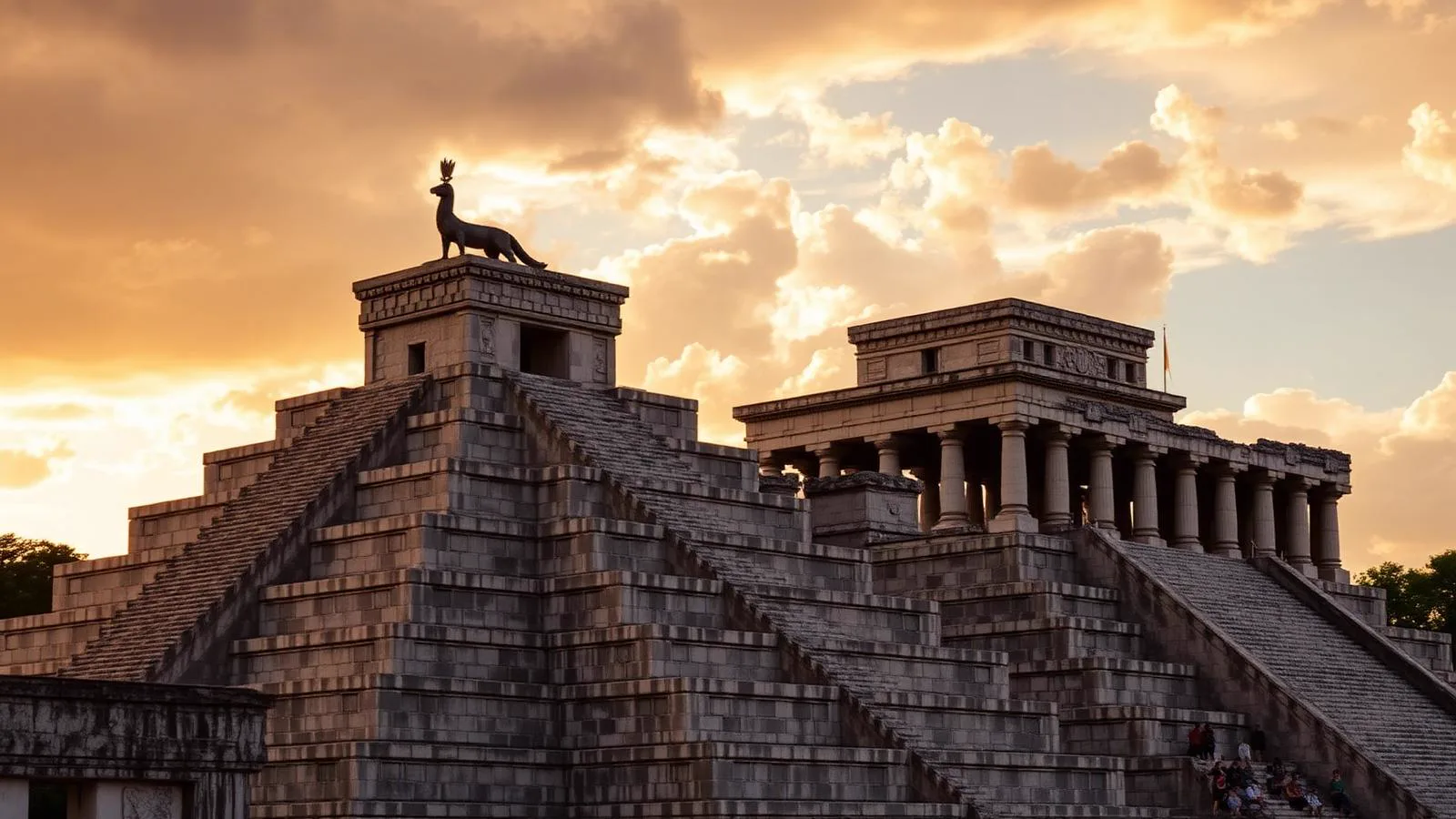
The Temple of the Warriors at Chichen Itza is a 12-metre stepped pyramid crowned by a reclining Chac Mool statue and two feathered-serpent columns, built between 900 and 1050 AD by the Itza Maya. Flanked by the Group of a Thousand Columns, it forms the largest single architectural complex at the site after El Castillo and served as the political and ritual centre of the city's peak era.
This guide covers the temple's location inside the archaeological zone, its exact dimensions, who Chac Mool actually was and what the belly bowl held, the real column count in the Thousand Columns complex, when the pyramid was built, the debunked Toltec-invasion myth, what the murals originally showed, the strict 2026 climbing rules, the best photography angle, and how the temple compares with El Castillo. Dates and figures follow INAH, UNESCO and current Mayanist scholarship.
What Is the Temple of the Warriors at Chichen Itza?
The Temple of the Warriors at Chichen Itza is a four-tiered stepped pyramid on a roughly square base, topped by a small columned temple where the reclining Chac Mool sits at the doorway. Its Spanish name, Templo de los Guerreros, comes from the hundreds of warrior figures carved onto the square pillars that surround it. The Itza Maya used the summit temple for state rituals; the columned halls around its base functioned as a colonnaded reception space for elite gatherings.
Two structures share the pyramid's platform base: the outer temple visible today and, buried inside, an earlier smaller shrine called the Temple of Chac Mool, uncovered by Carnegie Institution excavators between 1925 and 1928. Both belong to the same peak building phase as El Castillo, and both use the recurring Chichen Itza vocabulary of feathered serpents, Chac Mool figures and warrior reliefs. For the full political timeline of that peak era, see the Chichen Itza Maya history guide.
Where Is the Temple of the Warriors Located Inside the Site?
The Temple of the Warriors stands on the east side of the Great Plaza, roughly 100 metres north-east of El Castillo pyramid and 250 metres south of the Sacred Cenote. Walking the standard route from the west gate, you reach it as the third major stop, after El Castillo and the Great Ball Court. GPS coordinates: 20.6836° N, 88.5678° W. The Group of a Thousand Columns extends south and east from the pyramid's base, forming an L-shaped colonnade.
The temple's east-facing staircase looks directly at sunrise, which mattered for ritual timing: several benches in the columned halls face east, and the interior mural of a coastal village was oriented to receive dawn light. For a full plan of how the pyramid sits inside the wider archaeological zone, the Chichen Itza archaeological zone plan maps every major monument and walking distance.
How Big Is the Pyramid? Real Dimensions, Base, and Height
The pyramid rises 12 metres (about 40 feet) in four tiered platforms on a square base of roughly 40 metres per side. A single west-facing staircase, 15 metres wide, climbs directly to the summit; the summit temple itself adds another 3 metres of standing structure. Total footprint including the wrap-around Thousand Columns is close to 1,800 square metres, making it the second-largest architectural complex at Chichen Itza after El Castillo.
| Element | Measurement | Note |
|---|---|---|
| Pyramid height | 12 m (40 ft) | Four tiered platforms |
| Base per side | ~40 m | Roughly square |
| Staircase width | 15 m | West face, single flight |
| Summit temple height | ~3 m | Above top platform |
| Feathered-serpent columns | 2 | Flank temple doorway |
| Chac Mool statues at site | 1 (top) + 1 (inner) | Outer temple + buried inner temple |
Who Was Chac Mool and What Did the Reclining Statue Actually Do?
Chac Mool is a reclining stone figure carved with head turned 90 degrees to one side, knees drawn up, and hands holding a shallow bowl on the belly. The Chichen Itza example sits at the doorway of the summit temple, positioned so priests entering the shrine had to step around the bowl. Mary Miller and Karl Taube (1993) identified the belly bowl as an offering receptacle for extracted hearts, pulque, incense and blood during state sacrifice ceremonies.
The name Chac Mool means great red jaguar in Maya and was coined by Franco-American explorer Augustus Le Plongeon in 1875 after he unearthed a similar statue at Chichen Itza. Le Plongeon believed it depicted a Maya prince; modern scholars read it instead as an anonymous ritual intermediary, a stone messenger who delivered offerings from the living to the gods. The type is not exclusive to Chichen Itza; at least fourteen Chac Mool statues have been found across Mesoamerica, from Tula to Michoacán.
A second, older Chac Mool sits inside the buried inner Temple of Chac Mool, sealed off from tourists but preserved with much of its original red, blue and yellow paint. That inner statue, along with polychrome bench reliefs found in the same chamber, gives Mayanists the clearest surviving example of how the temple's exterior colours actually looked in the 10th century.
What Are the Thousand Columns and How Many Are Really There?
The Group of a Thousand Columns is an L-shaped colonnade wrapping the south and east sides of the Temple of the Warriors, made up of about 200 surviving columns, not a literal thousand. Two column types alternate through the complex: square pillars, each roughly 2.5 metres tall and carved with four warrior figures on their four faces, and plain round columns that once supported perishable wooden beams. Together they enclose a covered space of roughly 4,000 square metres.
The warrior reliefs on the square pillars are portraits, not generic decoration. Each face carries a different individual with distinct headdress, weapons and jewellery, Mayanists suggest they name specific captains, envoys and lineage heads of the Itza state. Miguel Ángel Fernández's 1930s excavation catalogued more than 400 unique warrior portraits, which makes the colonnade the largest surviving gallery of named military figures in Maya art.
When Was the Temple of the Warriors Built and by Which Maya Rulers?
The Temple of the Warriors was built between 900 and 1050 AD, during Chichen Itza's peak political era. Ceramic sequences and stratigraphy from the Carnegie Institution excavations place the earlier inner Temple of Chac Mool at roughly 900 AD and the outer temple at 950–1050 AD. Both fall inside the same building programme that raised El Castillo and expanded the Great Ball Court, meaning a single Itza dynasty commissioned every major monument in the northern group within a 150-year span.
Named rulers of that dynasty do not appear in the surviving inscriptions with the certainty they do at classic Maya sites such as Palenque or Tikal. What survives instead is a collective political identity, Itza, and glyphic references to a K'ak'upakal, a warrior lord attested on the Great Ball Court ring inscription and on hieroglyphic stairways at the site. Whether K'ak'upakal personally commissioned the Temple of the Warriors is still debated, but the temple sits inside his political era.
Was It Really Toltec? The Invasion Myth vs. Elite Exchange
The Temple of the Warriors was not built by invading Toltecs from central Mexico, despite a 20th-century tourist narrative that still circulates. The invasion model was proposed by Alfred Tozzer in 1957 based on stylistic similarities between Chichen Itza and Tula, feathered-serpent columns, Chac Mool statues, warrior reliefs, colonnaded halls. Cynthia Kristan-Graham and Jeff Karl Kowalski (2007) reviewed the entire body of evidence and demonstrated that the resemblance runs in both directions, not from Tula to Chichen Itza.
Current consensus reads the Maya-Toltec resemblance as elite exchange: high-status objects, iconography and craftsmen travelled in both directions along the same Gulf Coast trade routes that carried obsidian, jade and salt. Chichen Itza's warriors are not Toltec troops; they are Itza lords using an international style that also appears at Tula, El Tajín and Cacaxtla. The invasion story survived because it neatly explained the visual overlap, but the archaeology under it has quietly collapsed.
What Did the Murals and Polychrome Reliefs Originally Show?
The Temple of the Warriors was originally painted in vivid polychrome, red, blue, yellow, black and white, across every carved surface, most of which has weathered off. The clearest surviving record comes from Ann Axtell Morris, who spent the 1925–28 seasons at the site producing scale watercolour reconstructions of murals and reliefs the moment they were excavated. Her paintings, published in Temple of the Warriors (1931), remain the primary visual source because the originals faded within decades of exposure.
One mural in the inner temple depicts a battle at a coastal village of thatched wooden houses beside a green sea, with warriors in feathered headdresses attacking canoe-borne defenders. Another shows a raid on a walled Maya town. A third shows a procession of tribute-bearers approaching a seated ruler. Taken together the murals frame the Temple of the Warriors as a military-victory monument, a stone record of specific Itza campaigns rather than an abstract religious shrine.
Can You Climb the Temple of the Warriors in 2026?
You cannot climb the Temple of the Warriors in 2026, the staircase has been closed to visitors since 2006 and every year INAH has renewed the closure. The rope line begins at the base of the west staircase, and archaeological staff enforce it during opening hours. Approaching within 3 metres of the bottom step is allowed for photography; setting foot on any step is not. The closure applies year-round, including the spring and autumn equinox events.
The reason is straightforward conservation. Foot traffic during the 1970s–1990s eroded the stone treads and cracked several of the summit-platform slabs; wear on the Chac Mool base created ongoing risk of structural loss. The same policy applies to El Castillo, closed in 2006 after a fatal visitor fall. For a fuller list of what is and is not open to visitors on-site, the Chichen Itza schedule guide keeps the current rules mapped monument-by-monument.
Best Angle, Time, and Photo Tips for the Temple of the Warriors
The best angle on the Temple of the Warriors is from the north-east face of El Castillo at roughly 4:30 PM, when late-afternoon sunlight rakes across the west staircase and picks out the four platform layers in sharp shadow. Morning light between 8:00 and 9:00 AM lights the north side but flattens the staircase in shadow. Midday overhead sun kills the depth of the four tiers and makes the whole pyramid look flat in photos.
Chac Mool close-up
A 200mm lens on a full-frame body, or a 3× to 5× smartphone telephoto, frames the Chac Mool cleanly at the summit doorway. Stand at the base of the west staircase near the rope line and shoot slightly upward. Photography is free with handheld gear; tripods and drones require separate INAH permits and are usually refused for the northern group.
Warrior pillars wide
The Group of a Thousand Columns photographs best in a wide frame from the south-east corner, looking back at the pyramid, with the column rows leading the eye to the staircase. A 24–35mm focal length captures both the colonnade and the temple in one shot. For a full list of angle, light and lens choices across every major monument on site, the Chichen Itza photography walks through each pyramid, plaza and cenote.
How Does the Temple of the Warriors Compare with El Castillo?
The Temple of the Warriors is smaller than El Castillo but architecturally richer. Where El Castillo is 30 metres tall on a 55-metre square base with four identical staircases and no interior sculpture visible from the plaza, the Temple of the Warriors is 12 metres tall on a 40-metre base with a single staircase, a reclining Chac Mool at the doorway, two feathered-serpent columns, and a 200-column colonnade wrapping its south and east sides. El Castillo is designed as a solar calendar; the Temple of the Warriors is designed as a political monument.
Both pyramids are closed to climbing under identical INAH policy since 2006, and both were built in the same 100-year window during Chichen Itza's peak. For the full technical breakdown of El Castillo's dimensions, equinox shadow and inner pyramid, see the El Castillo pyramid.
Planning a Visit to the Temple of the Warriors
The Temple of the Warriors reads better on-site when you already know what to look for, the Chac Mool at the summit, the 200 warrior portraits in the colonnade, the 900–1050 AD build window, and the reason the staircase has stayed roped off since 2006. A guide who can walk you through the pillars naming the reliefs is worth more here than at any other monument on the plaza. Itza Quest operates Chichen Itza tour from Cancun, Playa del Carmen, Tulum and Merida with certified INAH guides.
Continue reading
Related guides with the same travel intent.
Frequently Asked Questions
How tall is the Temple of the Warriors at Chichen Itza?
The Temple of the Warriors stands 12 metres tall (about 40 feet), built as a four-tiered stepped pyramid on a square base roughly 40 metres per side. A single staircase on the west face climbs to the summit platform, where two feathered-serpent columns frame the temple doorway. Older tourist accounts that give heights of 20 or 23 metres refer to hypothetical rooftop crest heights, not the surviving structure.
Can you climb the Temple of the Warriors in 2026?
You cannot climb the Temple of the Warriors in 2026. INAH closed the staircase to visitors in 2006 for conservation, and the closure has held every year since. The reclining Chac Mool statue at the top is visible from the plaza with a telephoto lens, and a roped viewing line lets you approach the base of the stairs. Climbing was permitted from the 1930s through the 1990s but is now permanently prohibited.
What is the Chac Mool statue and what was it used for?
The Chac Mool is a reclining stone figure holding a shallow bowl on its abdomen, positioned at the entrance of the Temple of the Warriors. According to Mary Miller and Karl Taube (1993), priests placed offerings in the belly bowl during rituals, human hearts extracted in sacrifice, pulque (fermented agave), incense and blood. The name Chac Mool means great red jaguar in Maya, coined by explorer Augustus Le Plongeon in 1875.
How many columns are in the Group of a Thousand Columns?
The Group of a Thousand Columns holds about 200 surviving columns, not a literal thousand. The number is a Spanish colonial descriptor for the visual density of the colonnade. Two types appear: square pillars carved with warrior reliefs on all four faces, and plain round columns. The complex once carried a wooden roof supported by these columns, forming the largest covered space at Chichen Itza.
When was the Temple of the Warriors built?
The Temple of the Warriors was built between 900 and 1050 AD during Chichen Itza's peak era, on top of an earlier smaller temple known as the Temple of Chac Mool. Excavations by the Carnegie Institution in the 1920s revealed the buried inner structure with its own polychrome benches and murals still in place. The outer temple visible today was likely commissioned by the same ruling dynasty that expanded El Castillo.
Was the Temple of the Warriors built by the Toltecs?
The Temple of the Warriors was built by the Itza Maya, not by invading Toltecs. The older invasion model, based on stylistic similarities with Tula in central Mexico, has been rejected since Kristan-Graham and Kowalski (2007) showed the resemblance points to two-way elite exchange rather than conquest. Feathered-serpent columns, Chac Mool statues and warrior reliefs appear at both cities because Yucatan and central Mexico shared iconography during the 10th and 11th centuries.