
Chichen Itza vs Tulum Ruins: The 2026 Comparison From a Yucatan Local

Chichen Itza vs Tulum ruins 2026: honest side-by-side comparison. Real INAH entrance fees, size, time on site, crowd-by-hour data, cenote pairing (Ik Kil vs Dos Ojos), best departure city, and a 12-hour itinerary that lets you visit both in one day if you are short on time.
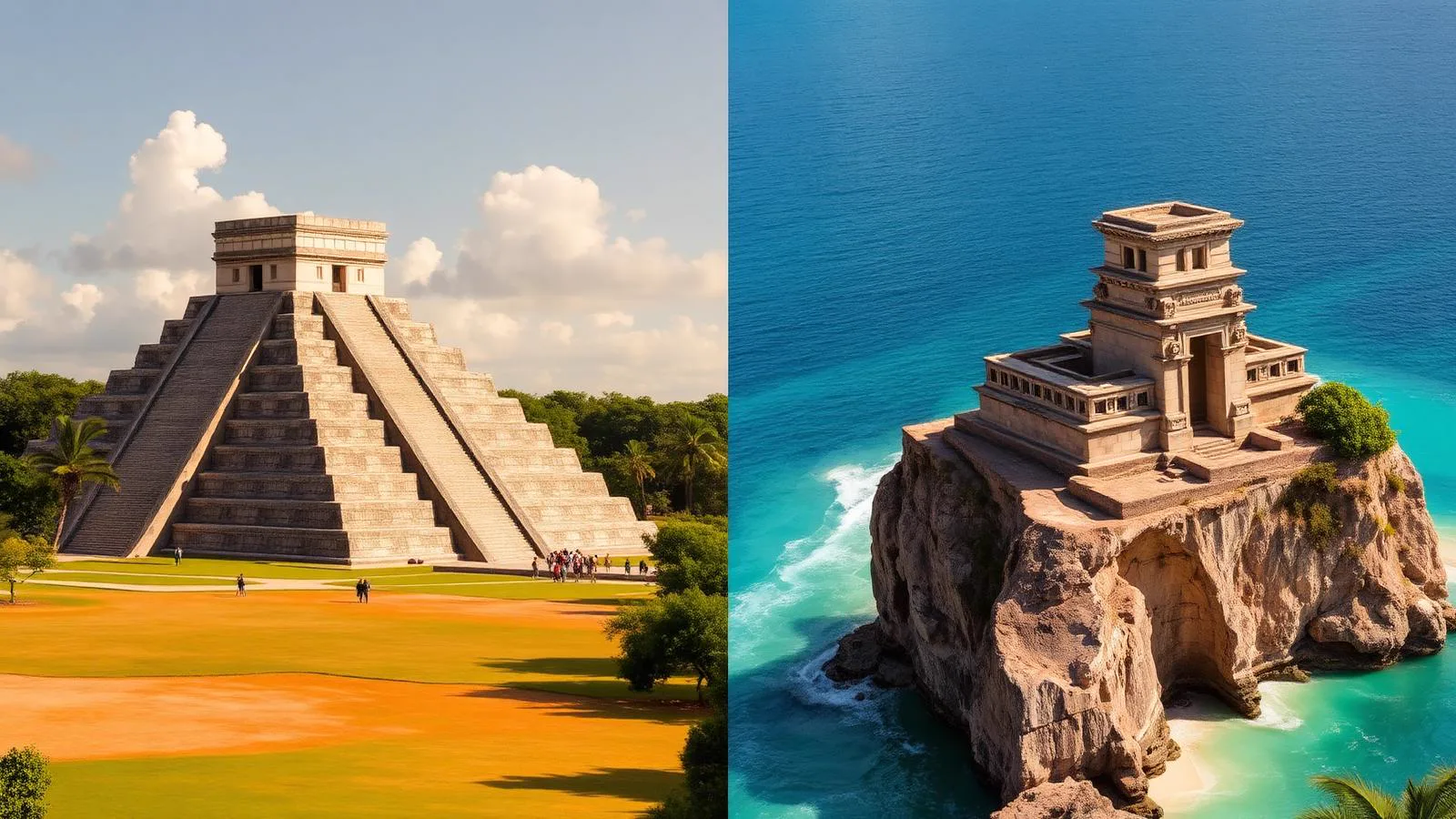
Chichen Itza wins on scale, UNESCO-grade architecture and New Seven Wonders status; Tulum ruins win on Caribbean-cliff scenery and half the travel time. Chichen Itza costs 720 pesos and a 12-hour day; Tulum costs 100 pesos and 4 hours. If you visit only one Mayan site in the Yucatan, choose Chichen Itza.
Chichen Itza vs Tulum ruins is the most-asked archaeological question in Mexico travel.
Both are Mayan sites administered by INAH on the Yucatan Peninsula, and both appear on every Cancun day-tour brochure. The similarities end there.
Chichen Itza is a 4 km² Terminal Classic capital that peaked between 600 and 1200 AD, dominated by the 24-metre Kukulcan pyramid and inscribed on the UNESCO World Heritage list in 1988. Tulum ruins are a 0.4 km² Post-Classic walled port city built between 1200 and 1520 AD, perched on a 12-metre limestone cliff over the Caribbean.
Chichen Itza vs Tulum Ruins: The 90-Second Verdict
First-time Yucatan visitors with a full day should choose Chichen Itza, the UNESCO capital delivers the Kukulcan pyramid, the largest ball court in Mesoamerica and the equinox serpent-shadow. Visitors already sleeping in Tulum or Playa del Carmen who want half a day of history plus beach should choose Tulum ruins for the cliff and cove.
With five or more days across the peninsula you can and should visit both, the two sites sit only 155 km apart along Highway 109 and Highway 307, and they answer different traveler questions rather than duplicating each other.
At-a-Glance Comparison: Chichen Itza vs Tulum Ruins in 2026
The at-a-glance comparison shows Chichen Itza is roughly 10x the mapped area, 7x the entrance fee and 3x the time on site compared to Tulum ruins in 2026. Tulum wins on distance from Cancun, cruise-day feasibility from Cozumel and beach access. Chichen Itza wins on every architectural, historical and educational metric.
| Factor | Chichen Itza | Tulum ruins |
|---|---|---|
| Site classification | UNESCO World Heritage · New 7 Wonders | INAH archaeological zone |
| Mayan period | Terminal Classic (600–1200 AD) | Post-Classic (1200–1520 AD) |
| Site area | ~4 km² mapped | ~0.4 km² (~10% of Chichen Itza) |
| Tallest structure | Kukulcan pyramid (24 m) | El Castillo Tulum (7.5 m) |
| 2026 foreign adult entry | 720 pesos (~USD 39) | 100 pesos (~USD 5) |
| Mexican citizen entry | 100 pesos | Free on Sundays with INE |
| Time on site | 2.5–3 hours (3.5 h with guide) | 60–90 minutes |
| Distance from Cancun airport | 200 km / 2h 40 min | 130 km / 90 min |
| Round-trip day total | 12 hours | 4 hours |
| Best paired cenote | Cenote Ik Kil (5 km) | Gran Cenote / Dos Ojos |
| Cruise-day feasibility from Cozumel | Not realistic | Yes (5–6 h window) |
| Setting | Dry Yucatan jungle plateau | Caribbean cliff-top |
| Guide value | Essential | Optional |
| Beach access on site | None | Cove below site |
| Peak crowd window | 10:00 a.m. – 1:00 p.m. | 10:30 a.m. – 2:30 p.m. |
Historical Depth: A Monumental Capital vs a Coastal Port City
Chichen Itza is a monumental capital of the northern Mayan lowlands; Tulum is a small Post-Classic coastal port and watch-station. Chichen Itza preserves 600 years of Maya-Toltec fusion architecture; Tulum preserves a walled trade outpost built 500 years later. The two sites answer completely different historical questions.
The Kukulcan pyramid encodes the solar calendar with 365 stairs and aligns with the equinox serpent-shadow phenomenon. It sits at the astronomical centre of a plaza flanked by the Temple of the Warriors, the Group of a Thousand Columns and the Great Ball Court, the largest in Mesoamerica at 168 metres long.
The Sacred Cenote north of the plaza served as a ritual sacrifice site. Its dredged offerings now sit in the Peabody Museum and the INAH collection in Merida. Chichen Itza was inscribed on the UNESCO World Heritage list in 1988 and voted one of the New Seven Wonders of the World in 2007.
Tulum was built during the Post-Classic period between 1200 and 1520 AD and served the Xelha–Chetumal maritime trade network. Its highlights are architectural in a domestic-scale way: El Castillo (a 7.5-metre platform temple on the cliff edge that once acted as a lit navigation marker for canoes), the Temple of the Frescoes and the Temple of the Descending God.
Tulum was one of the last active Mayan cities when the Spanish arrived; Juan de Grijalva sighted it from sea in 1518. Tulum is not UNESCO listed. If the deep Mayan story is what you came for, our long-form Chichen Itza Maya history walks the full 700-year arc.
Cost Reality: 2026 Entrance Fees and Total Day Budgets
Chichen Itza foreign adult entry costs 720 pesos in 2026, 100 pesos INAH federal plus 620 pesos Yucatan state CULTUR fee. Tulum ruins cost 100 pesos INAH federal plus a small parking charge. Chichen Itza is roughly 7x more expensive at the gate; the extra funds infrastructure and the Noches de Kukulcan light show.
Mexican citizens with INE pay 100 pesos at Chichen Itza and are free at Tulum ruins every Sunday. Children under 13 are free at both sites. Video cameras add 45–65 pesos at both; drones are prohibited at both.
Card payment works at both ticket windows in 2026, though cash queues move faster in high season. The complete price breakdown, including guide and transport add-ons, lives in our Chichen Itza ticket price.
| Cost item (2026, per adult) | Chichen Itza | Tulum ruins |
|---|---|---|
| INAH federal fee | 100 pesos | 100 pesos |
| State CULTUR fee (Yucatan) | 620 pesos | n/a |
| Total foreign adult entry | 720 pesos (~USD 39) | 100 pesos (~USD 5) |
| Mexican citizen with INE | 100 pesos | 0 on Sundays |
| Parking | 80 pesos car | 30–60 pesos car |
| Certified INAH guide | USD 60–90 group | USD 25–40 group |
| Round-trip transport Cancun | USD 40–80 shared / 220+ private | USD 25–50 shared / 140+ private |
| Sample full day tour | USD 60–140 with cenote + lunch | USD 45–90 with cenote |
Crowd Reality: When Each Site Is Empty and When It Is Packed
Both sites cap 8:00 a.m. opening at very low density and both peak in the mid-late morning as Cancun tour buses land. Chichen Itza is empty 8:00–9:30 a.m., peaks 10:00 a.m.–1:00 p.m., and thins fast after 2:30 p.m. Tulum ruins peak later and longer, 10:30 a.m.–2:30 p.m., because cruise ferries from Cozumel add to the morning day-trippers.
If you can only visit at midday, expect denser crowds at Tulum ruins than at Chichen Itza, because Chichen Itza's 4 km² area absorbs 8,000 visitors more easily than Tulum's 0.4 km² does 5,000. The density difference is roughly 4x in the peak window.
Getting There: Which Departure City Wins for Each Site
Chichen Itza is best reached from Valladolid (45 km / 40 min on Highway 180D with no toll); Tulum ruins are best reached from Tulum town (5 min) or Playa del Carmen (60 min on Highway 307). From Cancun, Chichen Itza is 2h 40 min via toll road; Tulum is 90 min via free coastal highway.
Cancun and Playa del Carmen work as bases for both. Cozumel cruise passengers can only realistically reach Tulum: the ferry plus 60-minute drive fits the 5–6 hour shore window, while Chichen Itza does not. Valladolid also anchors most private Chichen Itza tour itineraries because it bundles a cenote, lunch and a Mayan village into the return leg.
For door-to-door times and toll-vs-libre road choice, see our distance guides, how far Chichen Itza is from Cancun, from Tulum, and from Playa del Carmen.
Cenote Pairing: Ik Kil for Chichen Itza, Dos Ojos for Tulum
Pair Chichen Itza with Cenote Ik Kil (5 km south of the archaeological zone). Pair Tulum ruins with Gran Cenote (10 km inland) or Cenote Dos Ojos (23 km north on Highway 307). Almost every Chichen Itza day tour bundles Ik Kil at no extra cost; Tulum day tours typically add a cenote for USD 25–35.
Ik Kil is the deep circular open-well cenote that appears in every Chichen Itza promotional photo, with vines cascading 26 metres to the water. Gran Cenote is a shallow open jungle pool best for snorkeling; Dos Ojos is a double-cavern cenote, the best photographic cenote in the Riviera Maya. Read our full Ik Kil cenote before you book.
Photograph Value: Which Site Gives You the Better Shot
Tulum ruins deliver the single unbeatable postcard, El Castillo Tulum perched on a limestone cliff above turquoise Caribbean water. Chichen Itza delivers scale rather than colour, the Kukulcan pyramid from the northeast corner in 8:30 a.m. side-light stands 24 metres above an empty plaza. For beach postcards, Tulum wins; for monumental architectural portraits, Chichen Itza wins.
Neither site allows drones. Neither allows tripods at the main plazas without a paid film permit. Both work best in the 8:00–9:30 a.m. side-light window before the sun climbs overhead and flattens shadows.
Who Should Choose Chichen Itza and Who Should Choose Tulum
First-time Mexico visitors with one Mayan slot should choose Chichen Itza, its UNESCO and New Seven Wonders labels make it the single most bucket-list-satisfying archaeological visit in the country. Cozumel cruise passengers with 5–6 hours ashore should choose Tulum ruins, Chichen Itza is not achievable in the ferry window.
Photographers and honeymooners staying in Tulum should do Tulum ruins first (cliff shot at 8:00 a.m.) and add Chichen Itza on a separate full day. Families with kids under 8 default to Tulum for the shorter walk and beach reward; kids 8 and older handle the Chichen Itza walking distance.
History enthusiasts, architecture students and repeat Yucatan visitors should always prioritise Chichen Itza, the depth of what you can read into those 4 km² grows with every visit, while Tulum's smaller footprint reveals its full story in a single morning.
Combining Both: The 12-Hour Same-Day Itinerary That Actually Works
Combining Chichen Itza and Tulum ruins in a single day is possible only from a Tulum or Playa del Carmen base and only with a private driver. The two sites sit 155 km apart along Highway 109 and Highway 307, and no public bus runs a same-day schedule that leaves time for both.
Follow this 12-hour plan step by step:
- 6:30 a.m., leave Tulum, 2h 15m drive to Chichen Itza.
- 8:30 a.m., ticket booth for opening and walk the main plaza, El Castillo, Great Ball Court, Temple of the Warriors and the Sacred Cenote path.
- 11:00 a.m., leave Chichen Itza and drive 15 minutes south to Cenote Ik Kil.
- 11:15 a.m. – 12:45 p.m., swim at Ik Kil and eat the buffet lunch at the on-site restaurant.
- 12:45 p.m., 2h 15m drive back to Tulum via Highways 180D and 307.
- 3:15 p.m., arrive at Tulum ruins and enter before the 3:30 p.m. last-entry gate.
- 3:30 – 4:30 p.m., walk the 60-minute coastal loop while the crowds disperse.
- 4:30 p.m., descend to the beach cove below the site to close the day.
This is a hot 12-hour day and most travellers regret compressing it. But it is factually doable and beats missing either site if the calendar leaves no other window.
Final Verdict: Chichen Itza First, Tulum If Time Allows
Chichen Itza is the more important, more memorable and more educational of the two Mayan sites, and it is the one you should protect a full day for. Tulum ruins are a lovely 90 minutes of Caribbean-cliff photography and Post-Classic coastal-history that pair with the beach day you were already having.
Do not skip Chichen Itza on your first Yucatan trip to save two hours. If the calendar allows only one archaeological visit, choose the UNESCO capital and book a small-group private departure that bundles Cenote Ik Kil and Valladolid. Our team at Itza Quest builds custom Chichen Itza departures from Cancun for two to eight travellers, with certified INAH guides included.
Continue reading
Related guides with the same travel intent.
Frequently Asked Questions
Which is better to visit, Chichen Itza or Tulum ruins?
Chichen Itza is better for scale, UNESCO-grade architecture and historical depth; Tulum ruins are better for compact Caribbean-cliff scenery and half the travel time. If you only see one Mayan site in the Yucatan, choose Chichen Itza, it delivers the Kukulcan pyramid and New Seven Wonders status that Tulum simply cannot match.
How much does it cost to enter Chichen Itza vs Tulum ruins in 2026?
Chichen Itza foreign adult entry is 720 pesos total in 2026, 100 pesos INAH federal plus 620 pesos Yucatan state CULTUR fee. Tulum ruins are 100 pesos INAH federal plus small parking. Chichen Itza costs roughly 7x more at the gate. Mexicans with INE pay 100 pesos at both; Tulum is free on Sundays.
How much time do you need at Chichen Itza vs Tulum ruins?
Plan 2.5–3 hours on site at Chichen Itza (3.5 with a guide) to walk the plaza, Kukulcan pyramid, Great Ball Court and Sacred Cenote. Plan 60–90 minutes at Tulum ruins, the site is roughly a tenth of Chichen Itza's mapped area. Chichen Itza is a 12-hour round-trip day; Tulum is 4 hours.
Can you visit Chichen Itza and Tulum ruins in one day?
Yes, but only from a Tulum or Playa del Carmen base and only with a private driver, the two sites sit 155 km apart. A workable 12-hour plan leaves Tulum at 6:30 a.m., walks Chichen Itza 8:30–11:00 a.m., stops at Cenote Ik Kil, and enters Tulum ruins by the 3:30 p.m. last-entry gate.
Is Chichen Itza or Tulum ruins better for a family with kids?
Tulum ruins are easier for families with kids under 8, shorter walk, natural shade, iguanas everywhere and a beach cove for a swim reward. Chichen Itza suits kids 8 and older who handle 3 hours in open sun. Visit Chichen Itza 8:00–10:30 a.m. and pack 1.5 L of water per person.
Which is closer to Cancun: Chichen Itza or Tulum ruins?
Tulum ruins are closer to Cancun. From Cancun International Airport (CUN) it is 130 km / 90 minutes to Tulum along Highway 307, versus 200 km / 2h 40 min to Chichen Itza along Highway 180D. Cozumel cruise passengers can only realistically reach Tulum; Chichen Itza does not fit the ferry window.
Which cenote should I pair with Chichen Itza vs Tulum ruins?
Pair Chichen Itza with Cenote Ik Kil, the deep open-well cenote 5 km south of the ruins that appears in every Chichen Itza photograph. Pair Tulum ruins with Gran Cenote (10 km inland) for snorkeling or Cenote Dos Ojos (23 km north) for cavern photography. Most Chichen Itza tours bundle Ik Kil at no extra cost.
What are the opening hours of Chichen Itza vs Tulum ruins?
Chichen Itza opens 8:00 a.m. to 5:00 p.m., last entry 4:00 p.m., seven days a week. Tulum ruins open 8:00 a.m. to 5:00 p.m., last entry 3:30 p.m., seven days a week. Best arrival: 8:00 a.m. at Chichen Itza to beat Cancun buses; 8:00 a.m. or after 3:00 p.m. at Tulum to miss cruise groups.
Are the Tulum ruins really underwhelming compared to Chichen Itza?
Tulum ruins can feel small only if you arrive expecting Chichen Itza scale, El Castillo Tulum stands 7.5 m versus the 24 m Kukulcan pyramid. Visit Tulum for the Post-Classic Caribbean-cliff port setting, not for monumental architecture. The disappointment is almost always an expectations problem, never a site problem.
Which site is more accessible for wheelchairs and limited mobility?
Tulum ruins are more accessible on paper, small, mostly flat, with a paved shuttle from parking. Chichen Itza offers wheelchair access to the central plaza and rentable manual chairs, but outer temple groups sit on unpaved sacbé trails. For 3 hours with limited mobility, Chichen Itza's plaza still delivers more than a full Tulum loop.
Is a guided tour worth it at Chichen Itza vs Tulum ruins?
A certified INAH guide is close to essential at Chichen Itza, the astronomical alignments and Maya-Toltec iconography read as blank stone without context. A guide at Chichen Itza costs roughly USD 60–90 for a small group. At Tulum ruins a 30-minute USD 5 audio guide covers everything a walking guide would.
What is the best month to visit Chichen Itza or Tulum ruins?
November through early March is the best window for both, temperatures 24–30 °C, low humidity, no hurricane risk. Chichen Itza peaks around the March 20–21 and September 22–23 equinox windows when the serpent-shadow phenomenon descends the Kukulcan pyramid. Avoid mid-July through late August at both sites: peak heat, peak crowds, peak Sargassum at Tulum.