
Cenote Suytun: The Iconic Cave Cenote Near Valladolid

Cenote Suytun guide 2026: the stone platform and light beam near Valladolid, entry fee, hours, best time for the photo and how to get there.
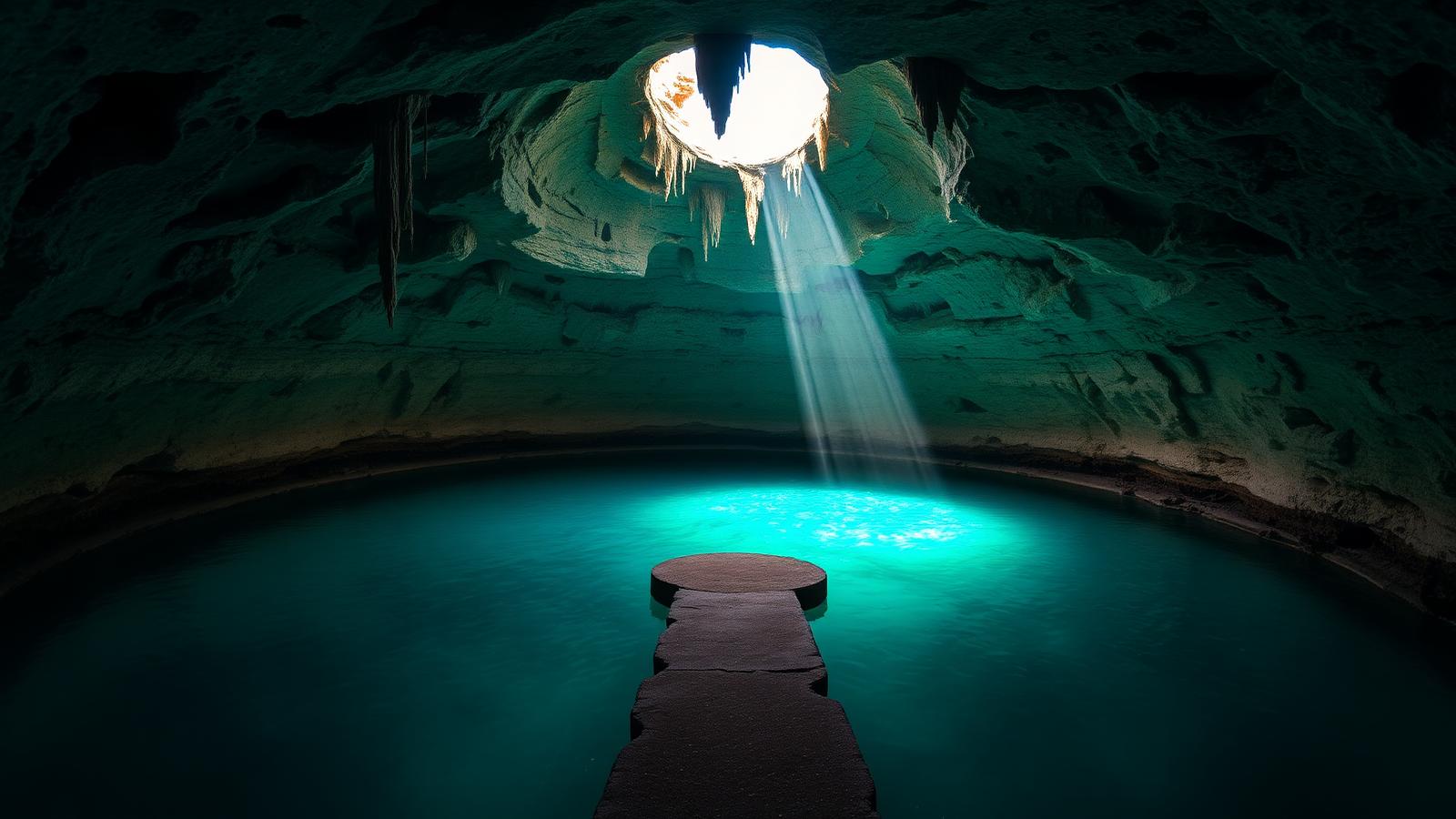
Cenote Suytun is a closed cave cenote 8 km east of Valladolid in Yucatan, Mexico, famous for a stone walkway that reaches a circular platform at the center of a shallow pool, and for the vertical beam of sunlight that falls through a circular opening in the cave ceiling onto that platform between roughly 11:30 AM and 1:30 PM on clear days. Entrance in 2026 is 200 MXN for foreign visitors, hours are 9 AM to 5 PM daily, life jacket included, swimming allowed. Suytun is the most photographed cenote on the Yucatan Peninsula, and the single image most non-Mexican travelers see before booking their first Yucatan trip.
This guide answers the questions searchers actually ask before they visit: where Suytun sits on the Yucatan map, what type of cenote it is geologically, the exact entrance fee and hours, how to time the light beam, whether to swim, how it compares to Ik Kil and to the nearby Cenote X'Kekén and Oxman, and how to get there from Valladolid, Cancun, Tulum, Playa del Carmen or the Riviera Maya.
What Cenote Suytun Is and Where It Sits in Yucatan
Cenote Suytun is a cave-type cenote, geologists classify it as a fully enclosed karst chamber, meaning the limestone ceiling collapsed only partially and left a mostly domed roof with a single skylight opening. The chamber is 35 meters across, the ceiling rises 8 to 10 meters above the water, and the entire back wall is lined with active stalactites that continue to drip and grow. The pool covers the full floor of the chamber, 1.5 to 4 meters deep, at a constant year-round temperature of 24 °C. The name 'Suytun' comes from the Yucatec Maya word for 'center of the stone'.
| Feature | Measurement |
|---|---|
| Location | Valladolid, Yucatan, Mexico |
| Coordinates | 20.6712° N, 88.1478° W |
| Cenote type | Closed cave (fully enclosed) |
| Chamber width | ~35 m |
| Ceiling height above water | 8–10 m |
| Water depth | 1.5–4 m |
| Water temperature | 24 °C year-round |
| Ceiling opening diameter | ~1.5 m |
| Distance from Valladolid | 8 km east |
| Distance from Chichen Itza | 45 km east |
| Distance from Cancun | 160 km west |
| Owned by | Private ranch (Hacienda Suytun) |
Cenote Suytun Light Beam: When It Appears and How to Photograph It
The Cenote Suytun light beam is a naturally-occurring solar phenomenon that happens because the single circular opening in the cave ceiling sits almost directly above the stone platform. When the sun climbs high enough to shine straight down through the opening, every clear day between roughly 11:30 AM and 1:30 PM, a defined column of light falls onto the platform. Peak intensity is 12:15 PM to 12:45 PM. The effect is strongest March through September when the sun tracks nearly overhead, weakest December through January when the sun sits lower and the shaft enters diagonally, and absent on cloudy days.
Practical photography rules that get you the shot: arrive by 10:30 AM to enter the cave before the platform queue builds; a wide-angle lens (16–24 mm full-frame equivalent) captures the full dome plus platform plus beam; expose for the beam not the shadows, the cave interior is meant to fall dark; a tripod is not allowed on the platform but is permitted on the entry stairs. Staff rotate visitors on the platform every 60–90 seconds during peak, so plan one shot per turn and re-queue if needed. Phones handle the scene well; the light contrast is the challenge, not resolution.
The beam window is also the peak-crowd window. If you come for atmosphere rather than the photo, enter between 3:00 and 4:30 PM when the chamber is nearly empty and the reflected turquoise light off the water is still beautiful. The beam is strongest March through September, to pick the exact month by weather and crowds see the best time of year for Chichen Itza. For an open swimming cenote without platform management, Cenote Ik Kil 40 km west is the standard complementary stop.
Cenote Suytun Entrance Fee, Hours and What Is Included in 2026
Cenote Suytun is privately owned and charges a single entry fee at the gate. For 2026 the foreign visitor rate is 200 MXN per adult (about $11 USD), the Mexican national rate is 120 MXN with ID, and children under 8 enter free. The ticket includes the mandatory life jacket loan, use of the changing rooms, cold-water showers, restrooms, and unlimited time inside the cave until closing. Photography is free. Lockers are 30 MXN extra. Payment is cash MXN preferred; card readers work when signal is available and there is no ATM on site.
Opening hours run 9:00 AM to 5:00 PM every day of the year including Sundays and holidays. Last entry is 4:30 PM. Sunscreen, insect repellent and hair products are prohibited inside the cave to protect the water; showers before entry are enforced. No food or drink inside the chamber. No drones. No tripods on the platform. Bags are allowed but a small locker for phones and wallets is recommended when swimming.
How to Get to Cenote Suytun from Valladolid, Cancun, Tulum and the Riviera Maya
Cenote Suytun sits 8 km east of Valladolid town on the Tekom highway, signed continuously from the town center. From Valladolid the drive is 10 minutes, from Chichen Itza 45 minutes east on Federal Highway 180 plus 8 km secondary road, from Cancun 2 hours 15 minutes west on the 180D toll road, from Tulum 2 hours 15 minutes north via Coba, and from Playa del Carmen 2 hours 45 minutes. There is free parking at the gate. The site does not have an ADO bus stop, colectivos run from Valladolid market for 20 MXN each way but drop 500 m short at the highway turnoff.
| Origin | Distance | Drive time | Route |
|---|---|---|---|
| Valladolid centro | 8 km | 10 min | 295 → Tekom road |
| Chichen Itza | 53 km | 50 min | 180 → Valladolid → Tekom |
| Ek Balam | 38 km | 45 min | 295 south → Valladolid → Tekom |
| Cancun airport | 160 km | 2 h 15 min | 180D → Valladolid → Tekom |
| Playa del Carmen | 220 km | 2 h 45 min | 307 → 180D → Valladolid |
| Tulum | 155 km | 2 h 15 min | Coba → Valladolid → Tekom |
| Riviera Maya | 200–240 km | 2 h 30 min – 3 h | 307 → 180D |
| Merida | 170 km | 2 h 00 min | 180D east → Valladolid |
The most efficient combination from the coast is Chichen Itza at sunrise, then Cenote Suytun at midday to catch the light beam, then return via Valladolid at sunset. For door-to-door service with private transport and a certified guide on that same loop, a Chichen Itza tour from the Riviera Maya can be built to include Cenote Suytun on request.
What Makes Cenote Suytun Different: The Closed-Cave Photo Cenote
Cenote Suytun answers one specific question, where in Yucatan do you get the vertical light beam falling on a stone platform, and no other cenote on the peninsula reproduces that image. It is a closed cave cenote with a single ceiling oculus, a circular built platform reaching into the water, wading-depth water (1.5–4 m) and stalactites hanging from the roof. That is why the queue at 11:30 AM exists: everyone came for the same photograph. What Suytun is not: it is not an open-water swim cenote and it is not a solitary cave. If you want to swim laps or jump from a ledge, Suytun is the wrong cenote, and the pairing decision (which cenote to combine with Chichen Itza) is a different question.
To pick the swim cenote you pair with the ruins, full comparison of Ik Kil vs Sacred Cenote vs Xkeken with distances, depths and crowd windows, that answer lives in the Ik Kil cenote, not here.
Is Cenote Suytun Worth Visiting? Who It Suits and Who It Doesn't
Cenote Suytun is worth visiting for travelers who came for the image, the stone platform and the vertical beam are exactly what the photos show, and no other cenote on the Yucatan Peninsula reproduces the effect. It is also worth visiting for anyone curious about closed cave cenotes, for stalactite geology, and for a short cool break after a morning at Chichen Itza or the pyramid climb at Ek Balam covered in the Ek Balam ruins guide. It is not the right cenote for open-water swimming, for solitude at midday, or for anyone who wants a full-body cenote experience without a queue. In those cases Cenote Ik Kil, X'Kekén or the nearby Oxman are better matches.
For the archaeological context of the sister site north of Valladolid, see the Ek Balam ruins guide.
The proven sequence from the coast: leave early, Chichen Itza at sunrise with less crowding, lunch in Valladolid, Cenote Suytun near midday for the beam, drive back at sunset. The same logic applies to anyone weighing whether Chichen Itza is worth it, the cenote turns the long day into something complete. A private Chichen Itza tour with Itza Quest can be assembled to cover the archaeological site plus Suytun plus lunch in Valladolid in a single day from Cancun, Playa del Carmen or Tulum. For travelers who want the curated version, premium vehicle, dedicated historian, an unhurried pace, the premium private Chichen Itza experience handles the same loop door to door.
If the stone platform and the queue for the beam photo are not what you came for, Cenote Oxman 4 km south of Valladolid is the open-air alternative, a 45-metre sinkhole with a rope swing, hanging roots and a hacienda pool deck, and it stays quiet through the same midday hours when Suytun peaks.
Continue reading
Related guides with the same travel intent.
Frequently Asked Questions
What is Cenote Suytun?
Cenote Suytun is a closed cave cenote 8 km east of Valladolid in the state of Yucatan, Mexico. It is a nearly circular limestone chamber about 35 meters wide with a shallow pool of turquoise water and a single circular opening in the domed ceiling. A stone walkway extends from the entry stairs to a round platform at the center of the pool, and around midday a vertical beam of sunlight falls through the opening onto the platform. That single frame, stone disk, beam, water, is the most photographed cenote image on the Yucatan Peninsula.
Where is Cenote Suytun located?
Cenote Suytun sits at 20.6712° N, 88.1478° W in the municipality of Valladolid, Yucatan, on the Tekom highway 8 km east of downtown Valladolid. It is 45 km east of Chichen Itza, 160 km west of Cancun, 155 km northwest of Tulum and 30 km southeast of Ek Balam. Access is off Federal Highway 180 through a private ranch that owns the cenote and operates the gate.
What is the Cenote Suytun entrance fee in 2026?
The Cenote Suytun entrance fee in 2026 is 200 MXN per adult (about $11 USD) for foreign visitors and 120 MXN for Mexican nationals with ID. Children under 8 enter free. The ticket includes a mandatory life jacket, use of the changing rooms, showers and the stone platform. Photography is free. Lockers are 30 MXN extra. Payment is cash MXN preferred; card readers work when signal is available.
What are Cenote Suytun opening hours?
Cenote Suytun is open 9:00 AM to 5:00 PM every day of the year including Sundays and holidays. Last entry is 4:30 PM. The light beam is only visible between roughly 11:30 AM and 1:30 PM on clear days, so most photographers arrive at opening 9 AM or plan to be inside the cave by 11:00 AM at the latest to secure a platform slot before the sunbeam window.
When does the light beam appear at Cenote Suytun?
The vertical sunbeam appears at Cenote Suytun between approximately 11:30 AM and 1:30 PM when the sun climbs high enough to shine through the circular ceiling opening. The peak, a defined shaft of light hitting the stone platform, is between 12:15 PM and 12:45 PM. The effect is strongest from March through September when the sun tracks nearly overhead at midday, and weakest in December and January when the sun sits lower and the shaft angles diagonally. Cloudy days produce no beam.
Can you swim at Cenote Suytun?
Yes. Swimming is allowed at Cenote Suytun and a life jacket is mandatory, included with the ticket. The water is shallow, 1.5 meters at the platform end, up to 4 meters at the far edge, and cool at about 24 °C year round. Sunscreen and insect repellent are prohibited to protect the water; showers before entry are required and enforced. The stone platform itself is not for swimming; it is a photography stand, and staff rotate visitors on and off every few minutes during the light-beam window.
Is Cenote Suytun crowded?
Yes, especially between 11 AM and 2 PM when the light beam is visible. In high season (December through April and July through August) the platform sees a line of 30 to 60 people waiting for a photo turn. Off-peak hours 9–10 AM and 3–5 PM are quiet and let you swim without a queue, but the sunbeam is not present. For a cenote without any crowd management, the twin cenote at Hacienda Selva Maya 200 m from Suytun is a much quieter alternative.
How does Cenote Suytun compare to Cenote Ik Kil?
Cenote Suytun is a closed cave cenote known for its stone platform and vertical light beam, an atmospheric photo destination with shallow water and limited swimming space. Cenote Ik Kil is an open cenote 40 km west near Chichen Itza with a 25-meter drop, deep 40-meter swimming pool and hanging tree roots, a full-body swim destination. Suytun wins on photography, Ik Kil wins on swimming. Serious cenote days visit both.